
Catching the Celestial Jellyfish
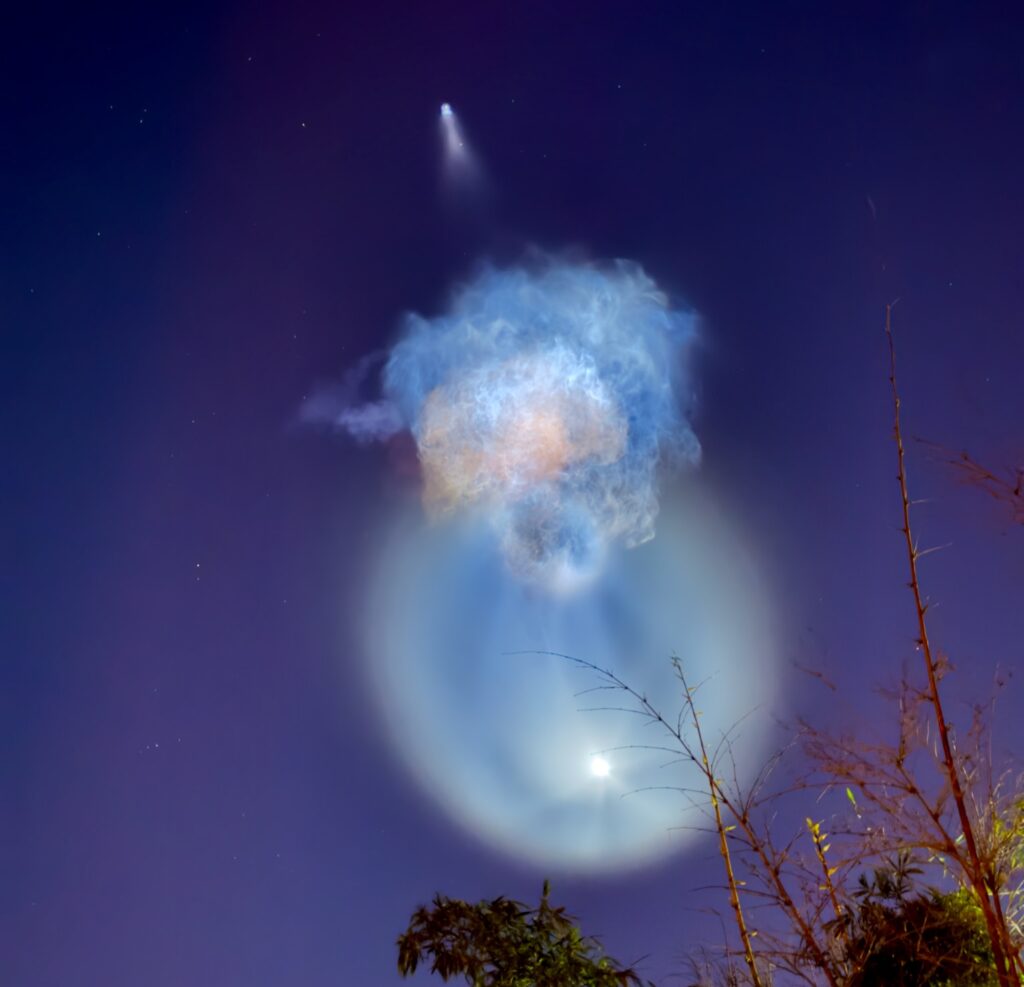
There is something profoundly surreal about catching a twilight launch right from the backyard. When the timing aligns just right, a standard rocket ascent transforms into a spectacular atmospheric show that I like to call the “Celestial Jellyfish.” This morning’s Falcon 9 launch offered a textbook display. Because this particular mission featured a steep, vertical Return to Launch Site (RTLS) trajectory to bring the booster back to the Cape, the entire choreography unfolded in a tightly stacked column right above us. Watching the components separate and fight their way through the upper atmosphere looks less like modern aerospace engineering and more like the vintage pages of the classic Buck Rogers comics I used to scour as a kid.
The vibrant, expanding canopy of colors is a beautiful convergence of fluid dynamics and high-altitude physics. As the rocket climbs into the near-vacuum of the upper stratosphere, the pressurized exhaust gases—primarily water vapor and carbon dioxide—instantaneously expand outward at supersonic speeds. The extreme ambient cold causes these gases to immediately freeze into a massive cloud of microscopic ice crystals. When the sun, still hidden below our horizon, strikes these high-altitude particles, Rayleigh scattering prioritizes the short, high-energy blue and purple wavelengths on the wispy outer fringes of the plume. Meanwhile, the dense central core where the exhaust plumes collide scatters warmer oranges and pinks, painting a stunning, glowing portrait across the dark morning sky.