

Orbits

Happy Leap Day!

In recent years, I have turned to star gazing. I am particularly fascinated by how the Moon, planets, and stars move through the sky. The Moon, in particular, never seems to be where I think it should be or oriented the way it is!

Today is a very special, interesting day. For the longest time, I thought that the extra day added every four years was to account for the fact that there are approximately 365 1/4 days per year. So 4 times 1/4 is equal to one day. And since it’s not exactly 1/4 of a day, we skip the extra day every 400 years.

Sort of….

It turns out the real story is much more complex and interesting! I recently read an article in Big Think about what a day and year actually mean in terms of Earth’s orbit around the Sun and the influence of the Moon on Earth. It points out how this has changed over the millennia. For example, days last only 6-8 hours during the early days of the earth!

Rotating While Rotating

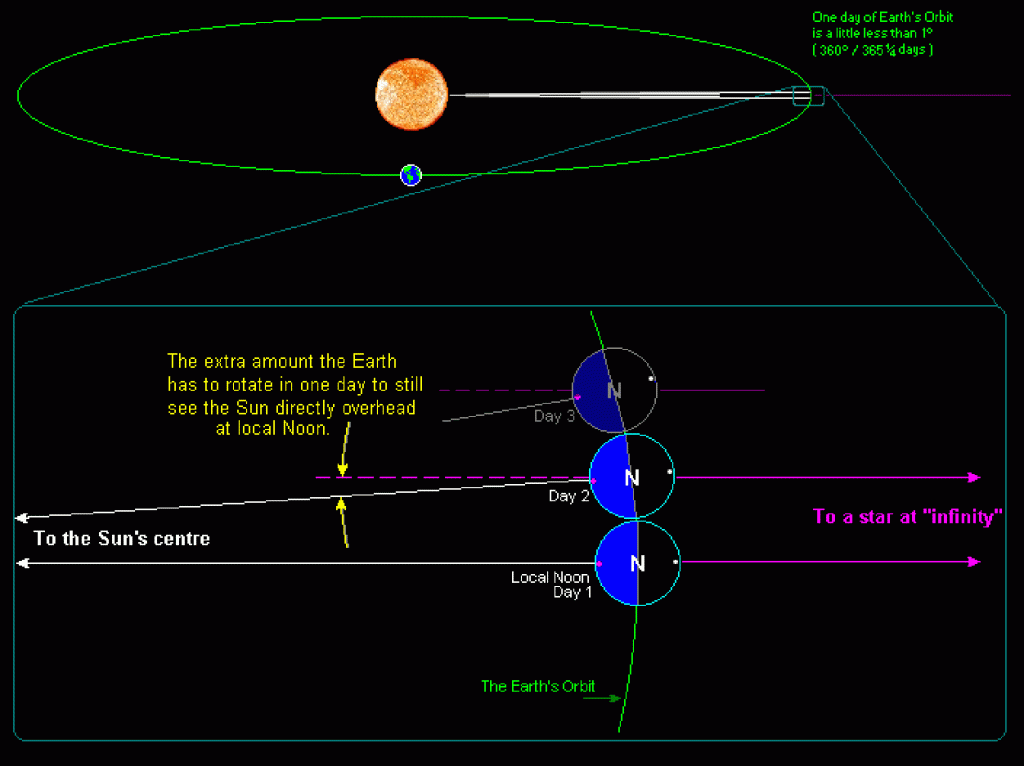
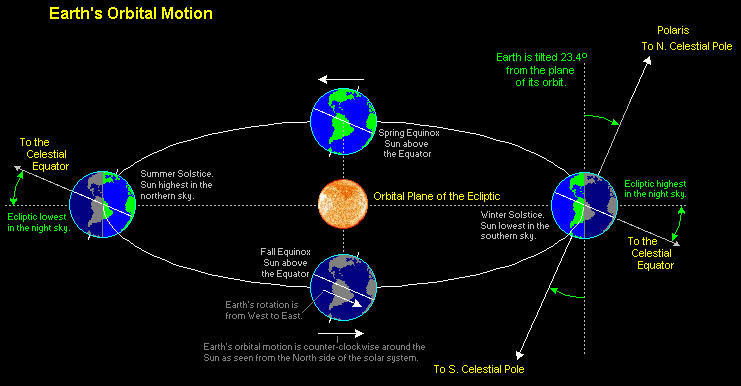
As the Earth rotates daily, it is more slowly circling the Sun. This introduces a variation when the Sun peaks during the day. The result is that what we perceive as a ‘day’ from the Sun’s position is a little longer than it takes for Earth to complete a complete (360-degree) rotation (23 hours and 56 minutes and 4.09 seconds)

To travel once around Earth’s orbit in a path around the Sun is a journey of 940 million kilometers. The extra 3 million kilometers that Earth travels through space per day ensures that rotating by 360 degrees on our axis won’t restore the Sun to the same relative position in the sky from day to day. This is why our day is longer than 23 hours and 56 minutes and 4.09 seconds, which is the time required for the spheroidal Earth to spin a full 360 degrees. Similarly, a β€œyear” is not the time it takes for Earth to make a complete 360-degree revolution around the Sun but is determined by the return of its axis to the same position relative to the Sun to the year before.

I’ve always found it interesting to think about how ‘fast’ we are going on Mother Earth relative to a fixed point in space. The earth moves at roughly 67,000 mph in its journey around the sun. It seems that Earth’s cruise control doesn’t work very well as we are slightly changing speed during the course of one revolution around the Sun!

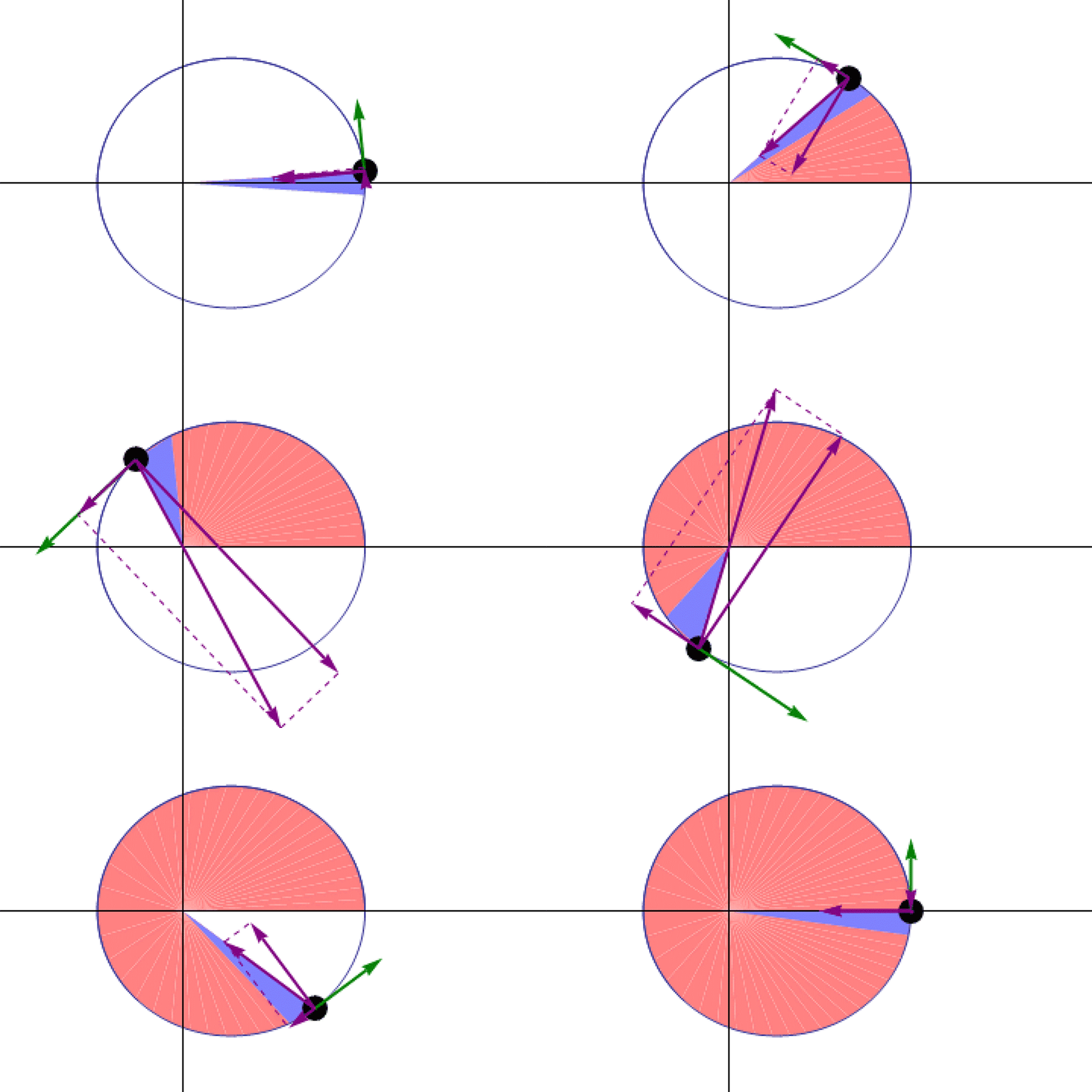
Before we understood how the law of gravity worked, we were able to establish that any object in orbit around another obeyed Kepler’s second law: it traced out equal areas in equal amounts of time, indicating that it must move more slowly when it’s farther away and more quickly when it’s closer. For extremely elliptical orbits, such as comets, the velocity near perihelion is enormous, while the velocity near aphelion is relatively tiny.

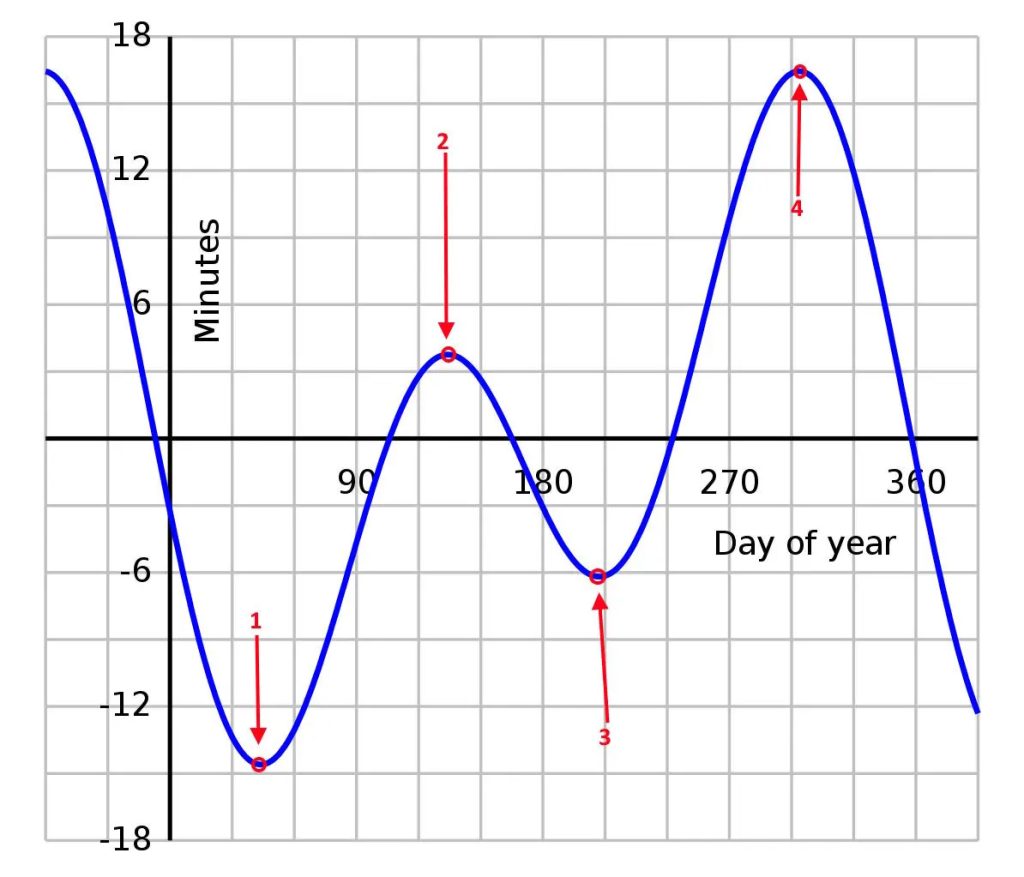
This means that the length of one-day changes and doing so in the most interesting way!

This graph shows the equation of time for a specific location on Earth. Where the slope of the graph is positive, days are shortening; where the slope is negative, days are lengthening; where the slope is zero (at the four locations marked), the day is precisely 24 hours. This happens four times per year in a latitude-dependent fashion.

This is another very cool example of complex sinusoidal motion and waveforms. Fascinating!

What Exactly is a Year Anyway?

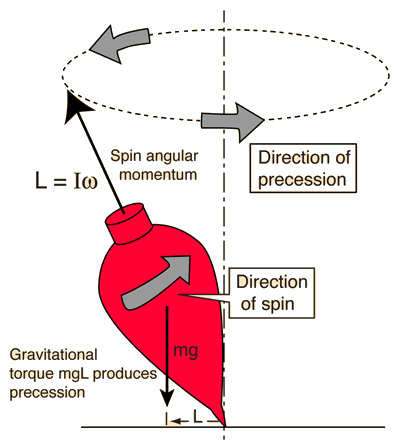
The next cool fact is a little hard to grasp at first. I’ve always known that the Earth’s rotation axis is tilted (23.5 degrees), but it turns out the axis precesses over time (20,000 years).

Think of a spinning top where you see the very top wobble to trace a circular path.

The Earth, moving in its orbit around the Sun and spinning on its axis, always defines β€œnoon” and β€œmidnight” in the same fashion: where the Sun’s height above or below the horizon is maximized. This moment in time doesn’t correspond to when Earth has rotated 360 degrees from the prior day, but rather closer to 360.9856 degrees, owing to the added effects of Earth’s motion around the Sun.

The net effect is that every time the Earth completes a full rotation around the Sun, it is positioned slightly differently than the previous rotation. The time it takes for four complete seasons (for example, the time between summer solstices) is 20 minutes shorter than for one full rotation around the Sun.

Long, Slow Burn

Finally, it makes sense to me that everything is slowing down. It’s sort of like increasing entropy. I was surprised to learn that over the course of Earth’s history, it has slowed from 6 to 8 hours a day to 23 hours, 56 minutes, and 4.09 seconds.

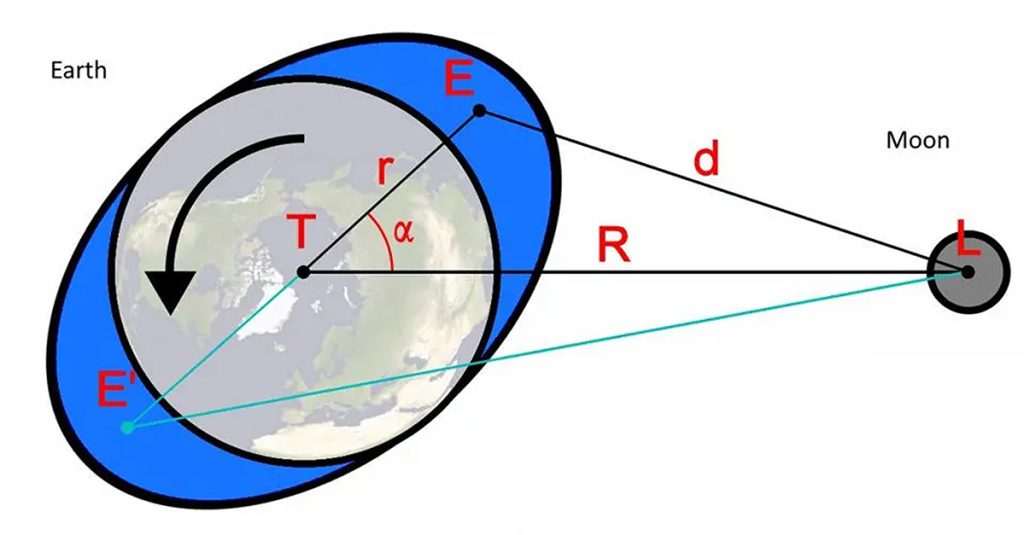
The Moon exerts a tidal force on the Earth, which not only causes our tides but also causes braking of the Earth’s rotation and a subsequent lengthening of the day. The asymmetrical nature of Earth, compounded by the effects of the Moon’s and Sun’s gravitational pulls, causes the Earth to spin more slowly. To compensate and conserve angular momentum, the Moon must spiral outward. For this reason, Earth will no longer have total solar eclipses after another 600 million years, and the length of each day will get longer as time progresses.

If we keep using our current calendar, we will eventually not need a leap day and will even have to eventually remove a day from the calendar rather than add one.

Just How Fast Are We Going, Anyway?

One other cool fact. While traveling at 67,000 mph around the Sun, the Sun is rotating with a fantastic velocity of 448,000 mph around the galactic center (a big black hole called Sagittarius*). The Milky Way itself is moving 1,300,000 mph through the Universe.

What Does This All Mean?

Check it out!

The Dude Abides 😎!

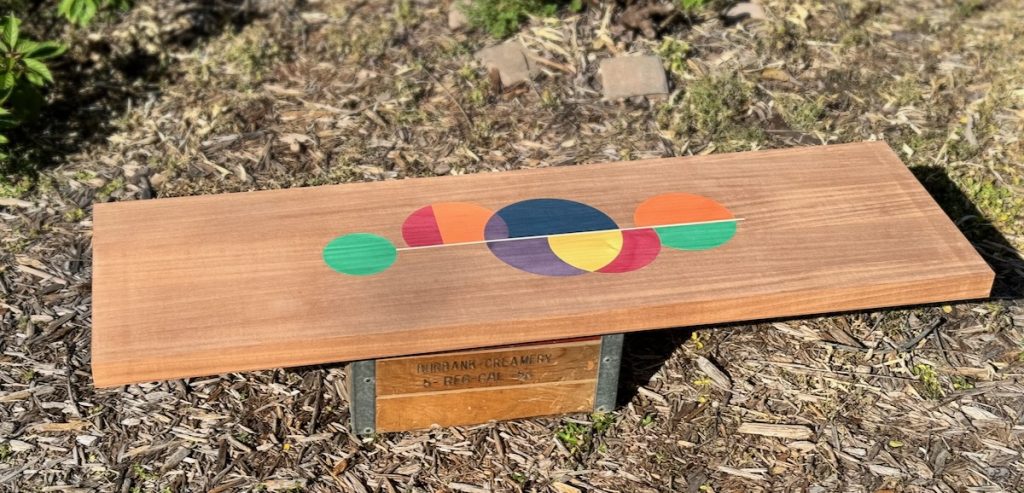
Inlayed Mahogany Table

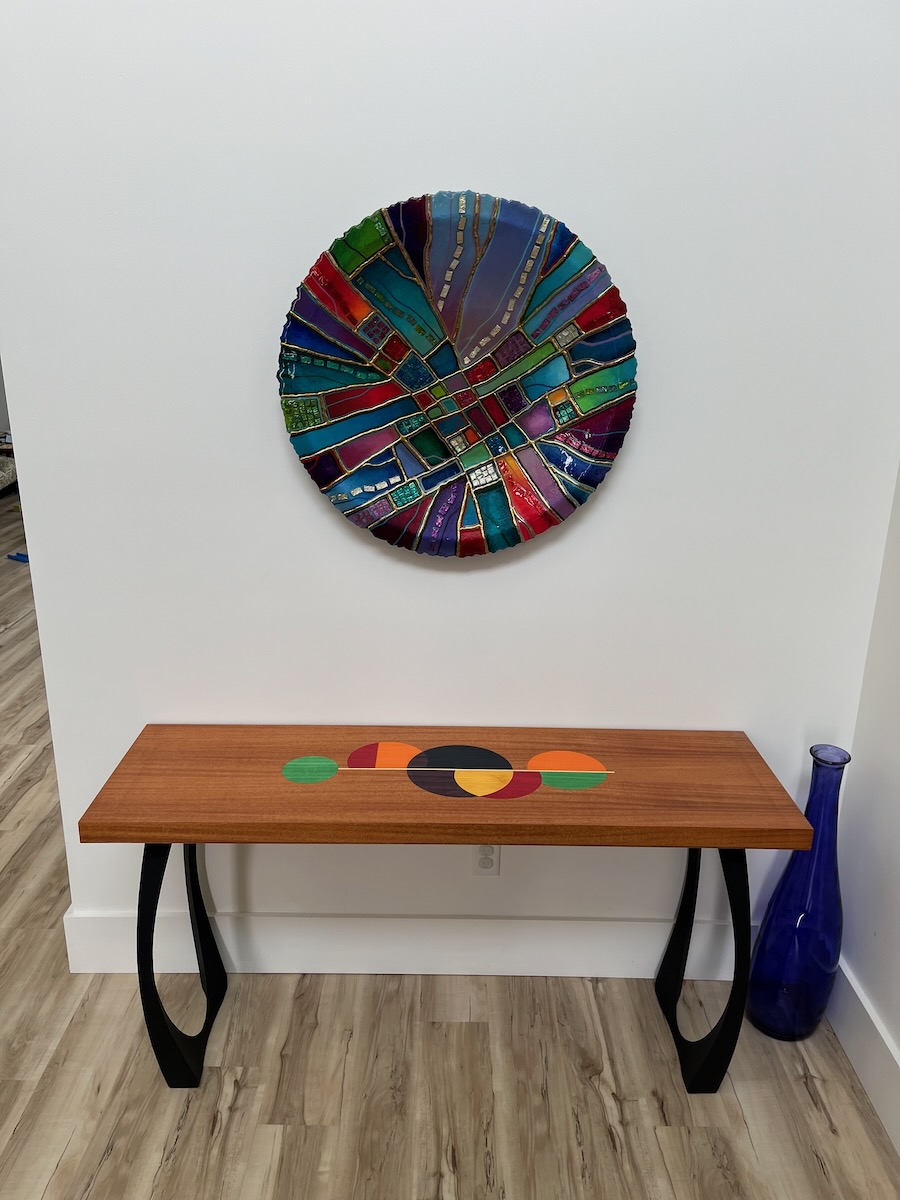
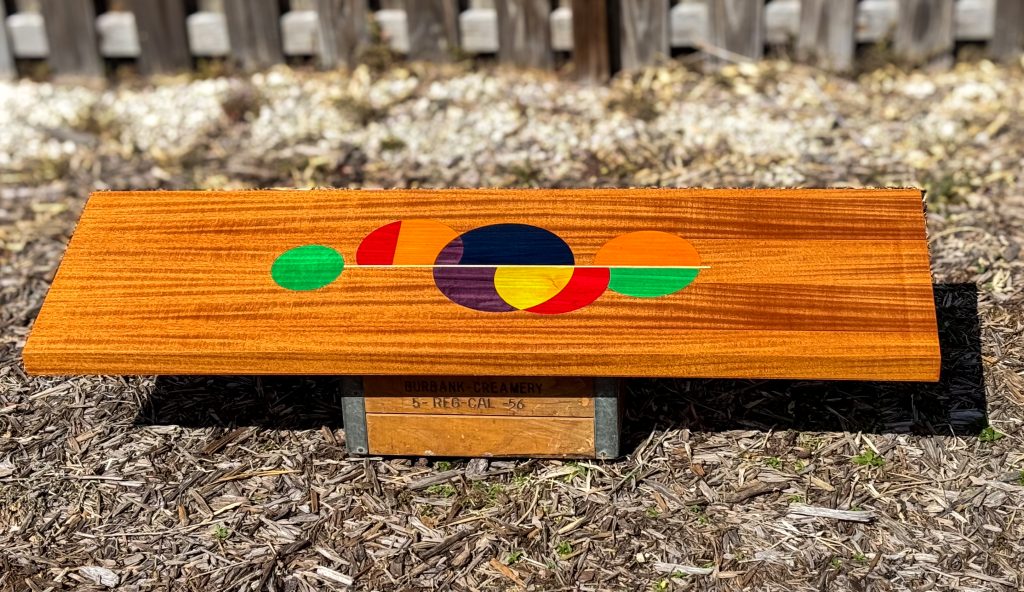
Finished Table at Brother Daves

My most recent woodshop project came from an idea my brother Dave had. They have been decorating their new home with art and furniture reminiscent of the midcentury modern style. Dave had an idea for a design with colors that matched some of their other art.

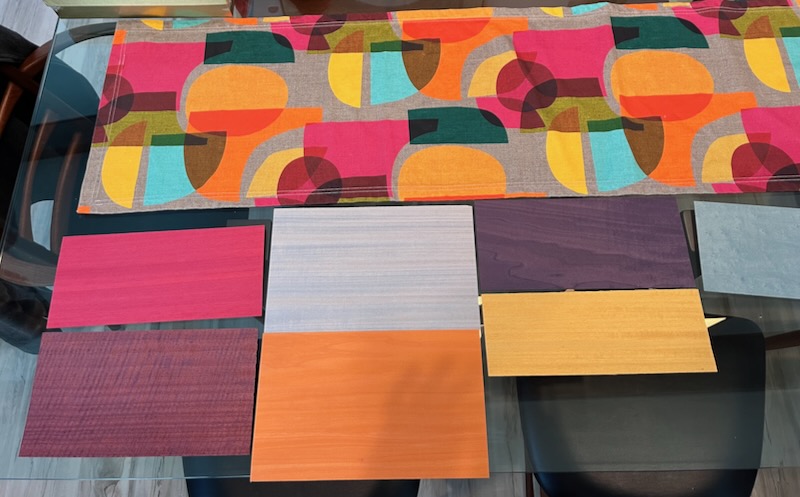
I had some colored veneer from an older project that we looked at with a table runner they had. Things were looking good!

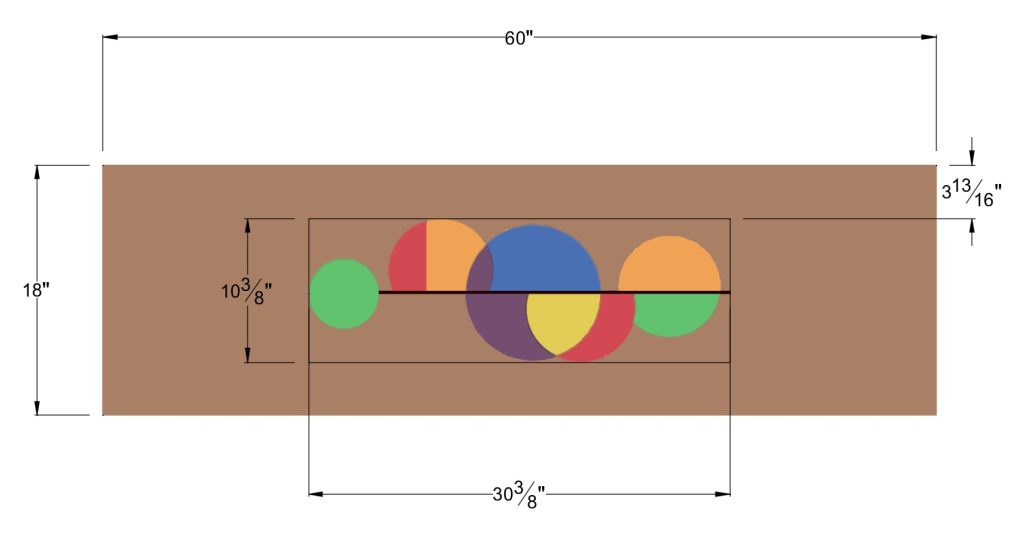
I worked up a design in AutoCad using the image as a guideline.

Dave wanted to match the wood to the mahogany used on their beautiful doorway. I was able to get a beautiful quartersawn veneer online together with the dye-strained colored veneer. We were in business!

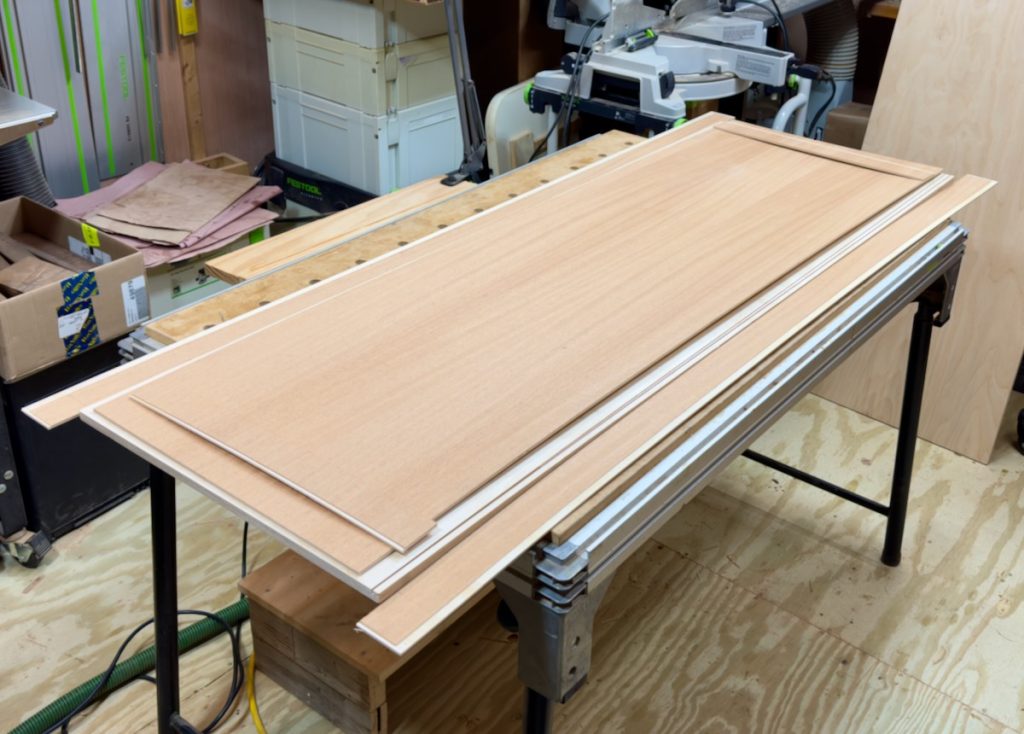
I carefully laid out the first cut after gluing the veneers to 1/8″ baltic birch plywood.

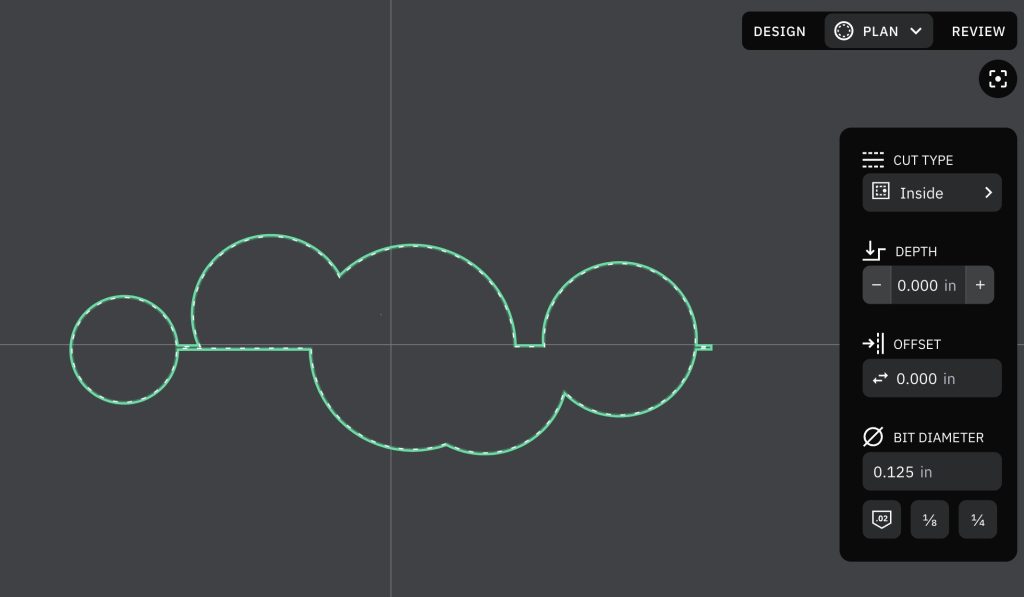
The outline of the shape was extracted from the AutoCAD file. I imported it into the Shaper Studio software and uploaded it to the router.

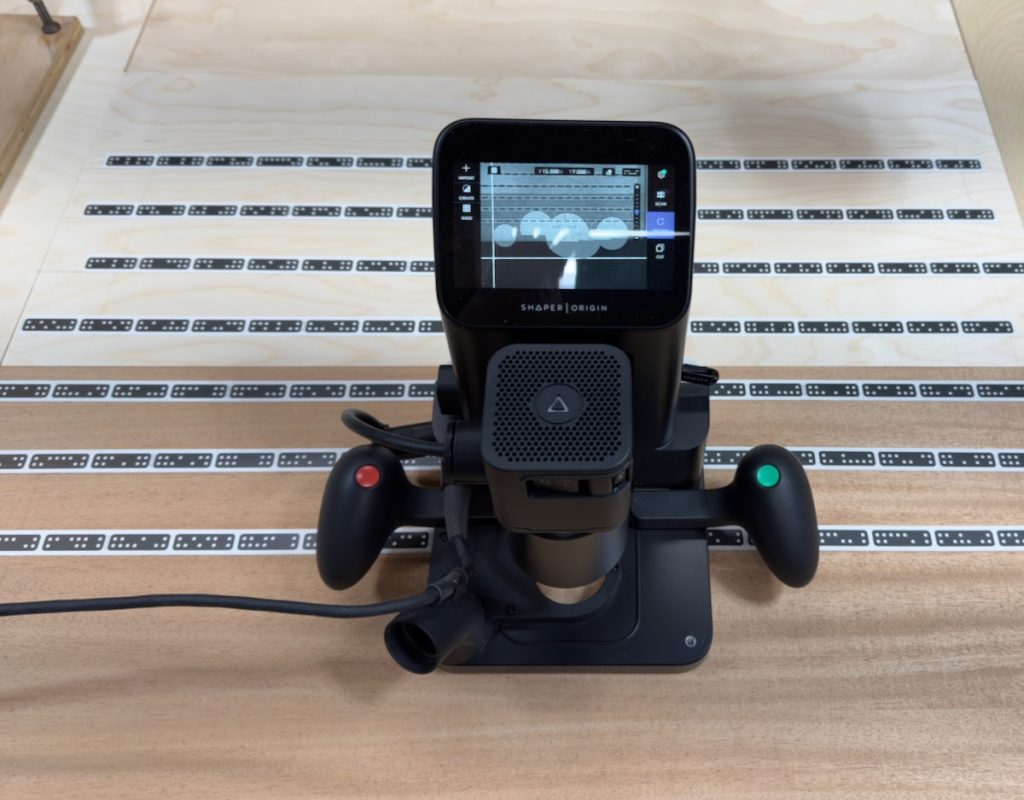
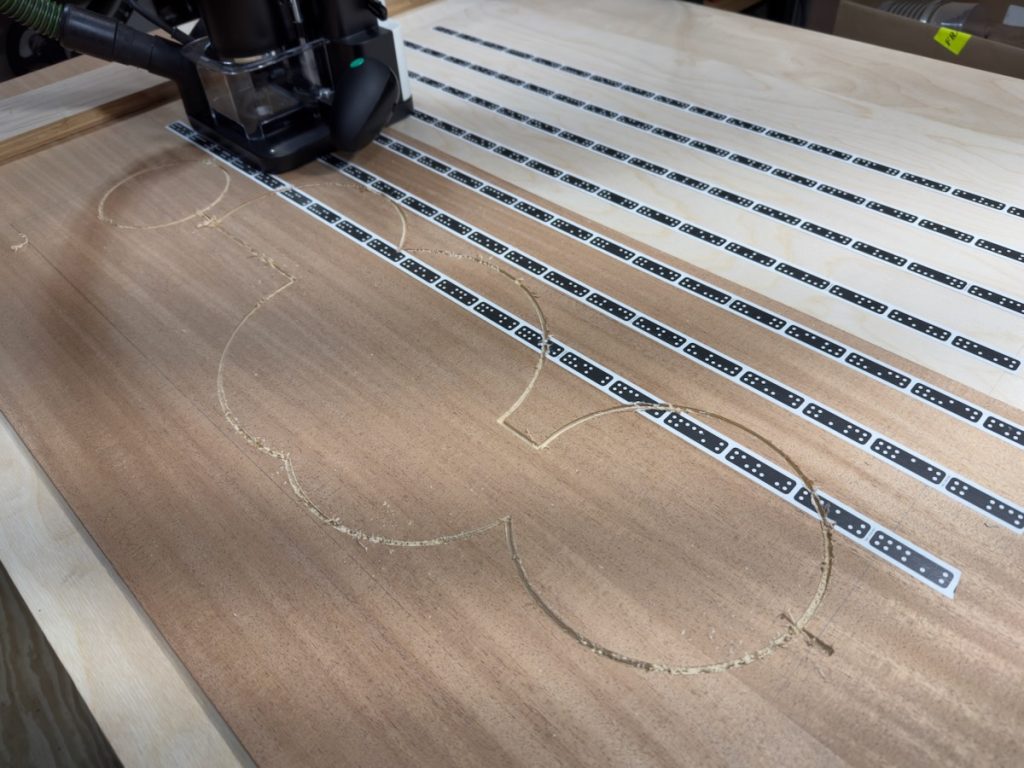
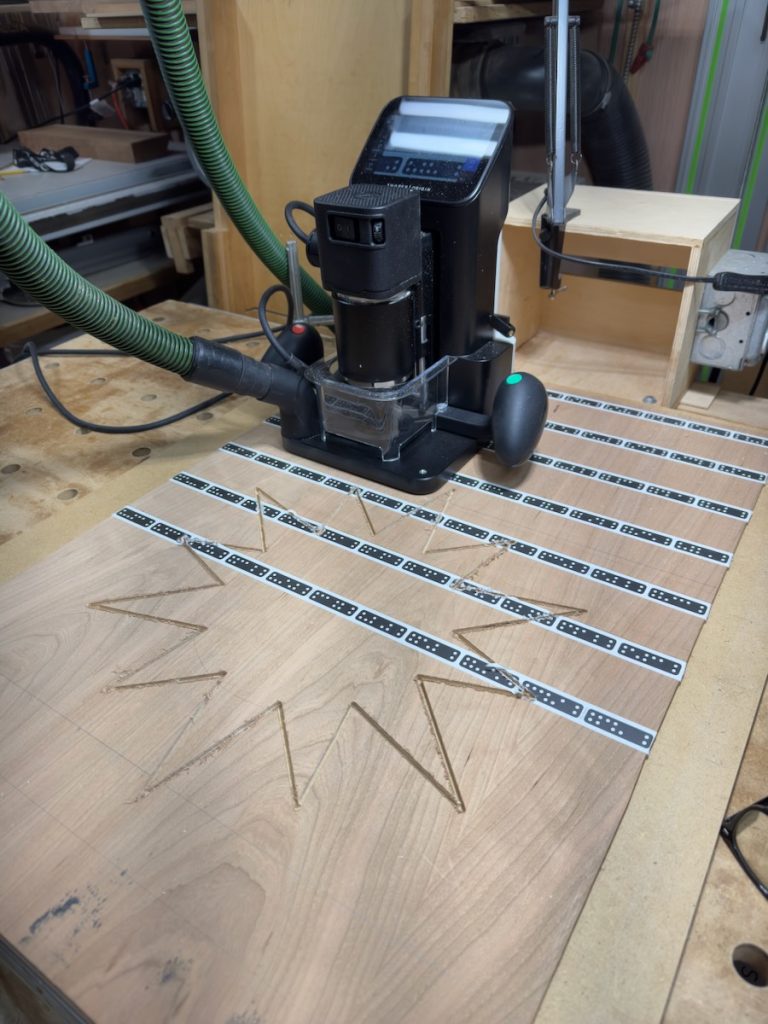
Making the cut in the tabletop for the individual wood shapes involved setting up the markers that the router used to determine cutter positioning. The markers extend slightly beyond the top and into the workpiece. This allows the router to determine its position with an accuracy of 0.001″. Pretty amazing!

The workpiece is secured to a panel underneath it using double-sided tape. The markers mustn’t move relative to the workplace, so care must be taken to ensure this with the tape and how the markers are laid out. Otherwise, the router displays an error message that the scan is unacceptable. However, once placed, it is accurate and, even more importantly, completely repeatable.

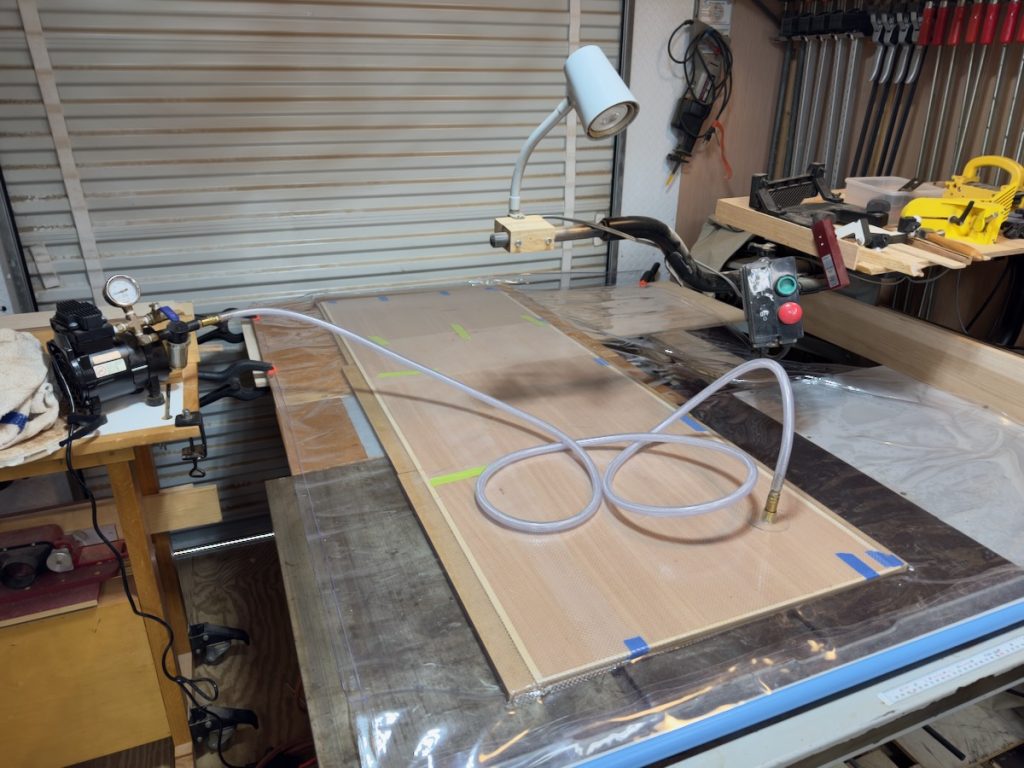
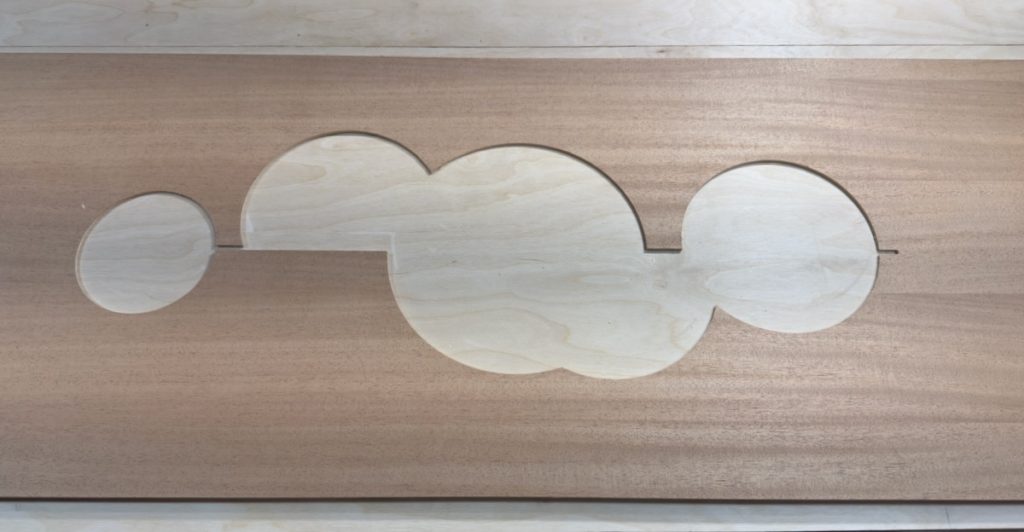
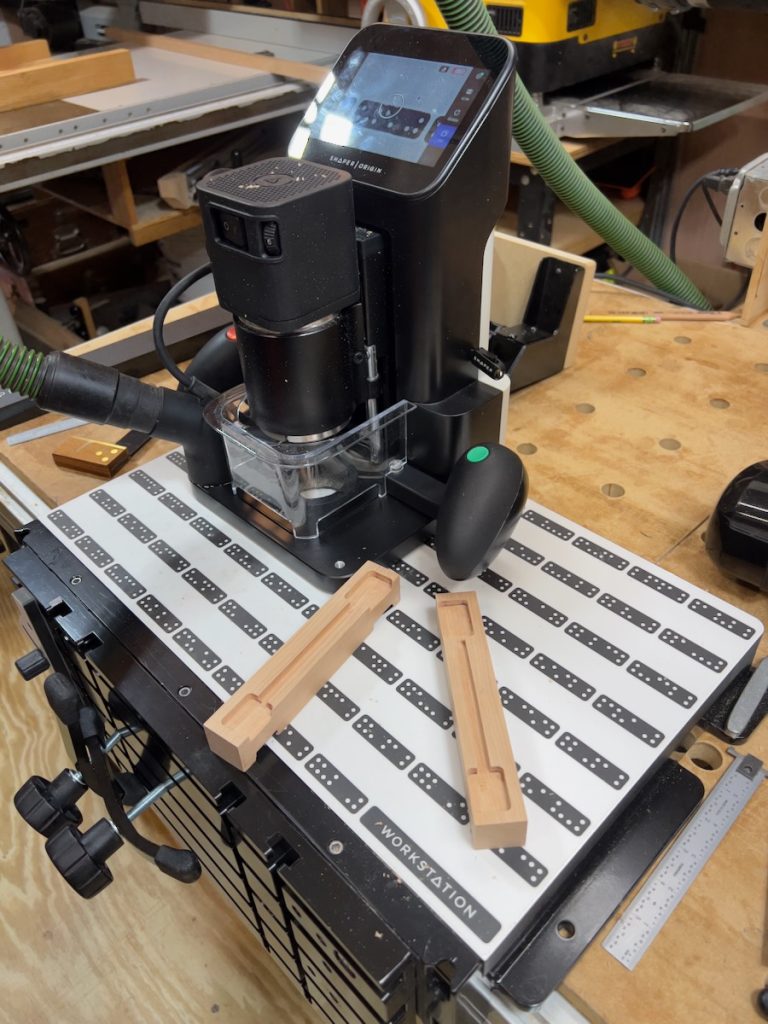
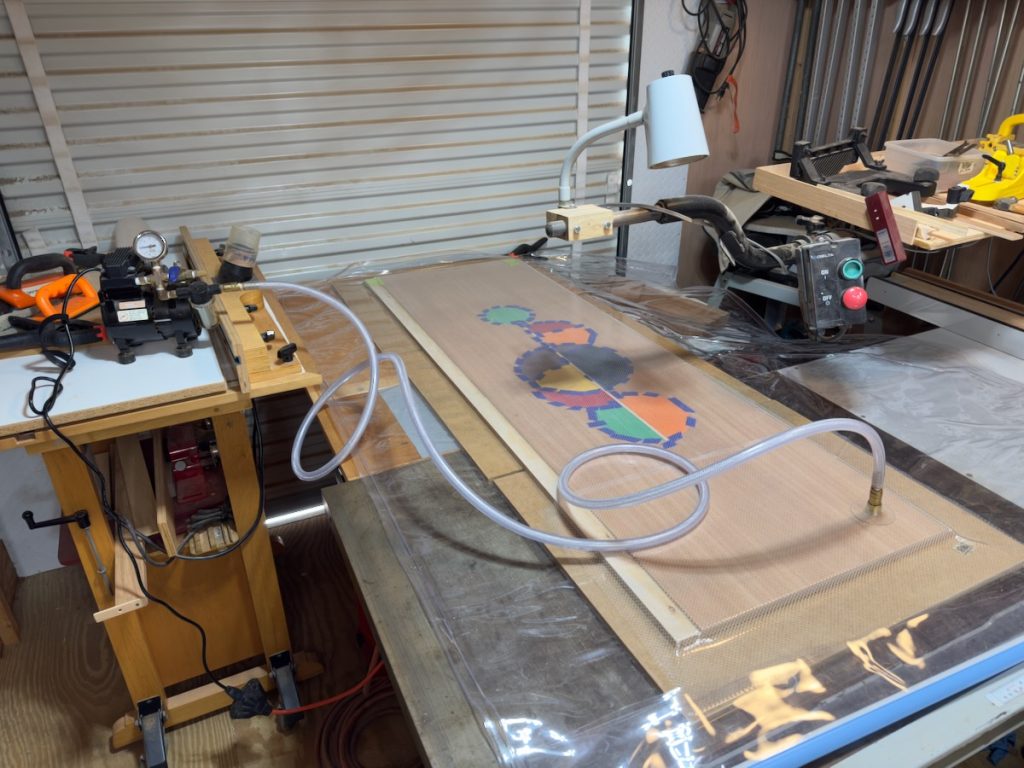
The next step is to cut and fit the individual pieces. They are vacuum glued to the 1/8″ plywood and cut using the Shaper Workstation. This accessory is handy for items up to about 12″ long and 5″ wide.

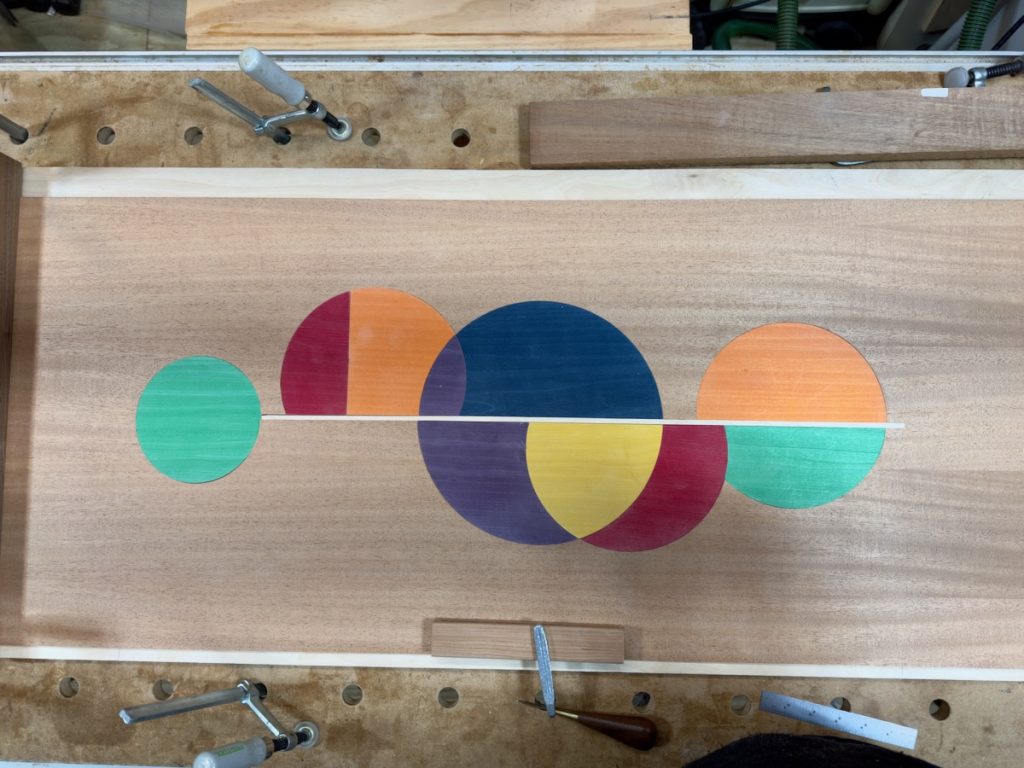
All the shape pieces were cut and fit into the panel. A solid strip of hard maple is placed in the middle. About 1 hour of sanding was needed to fit all the pieces in place smoothly. It went smoother than I expected.

All the shapes were then glued to form the tabletop.

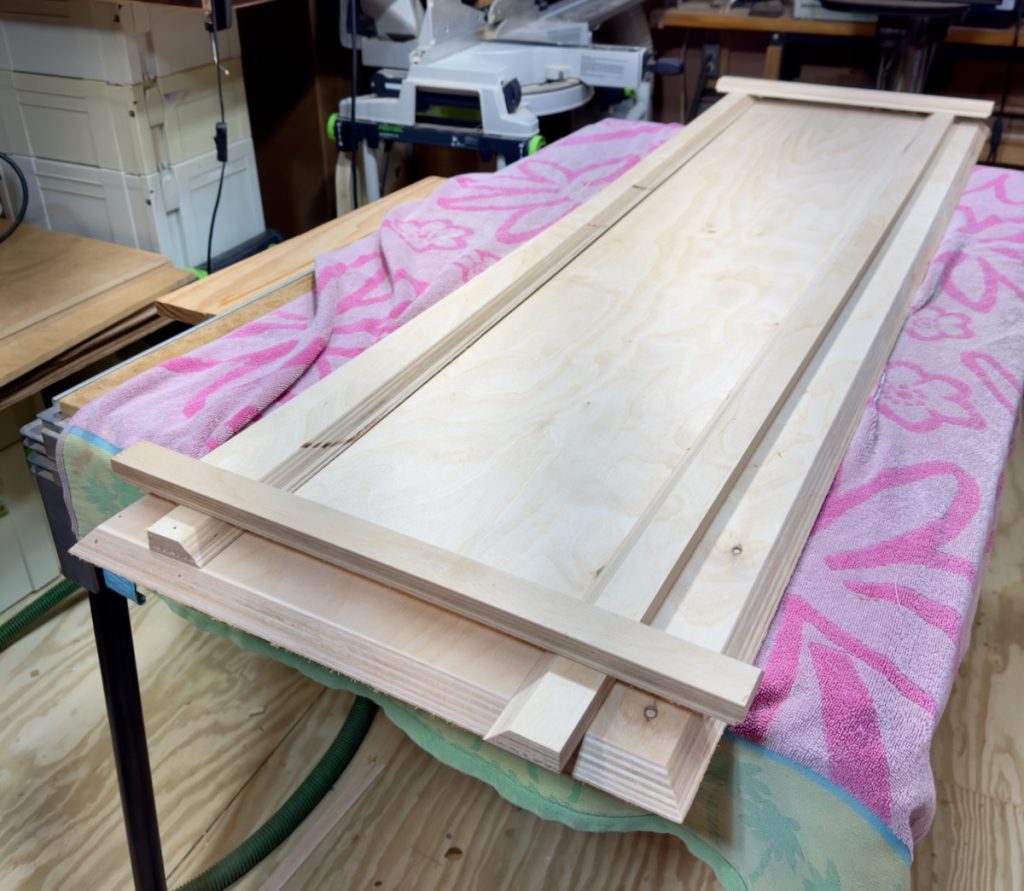
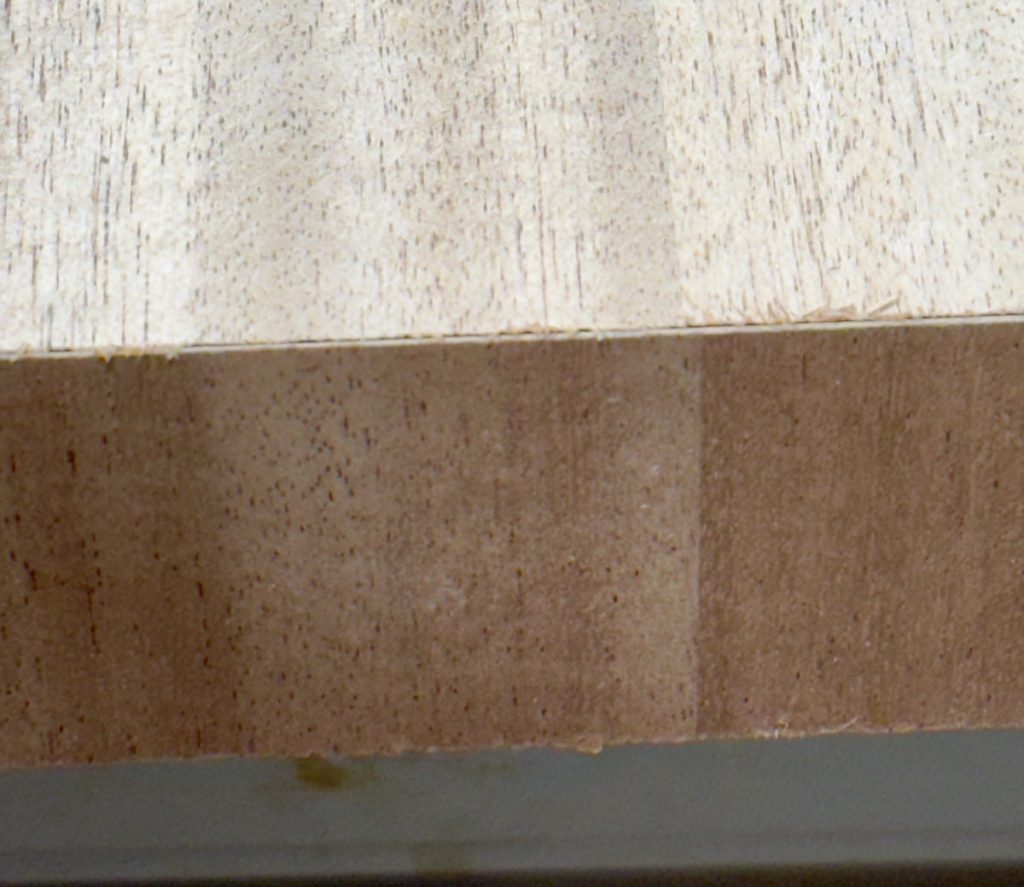
The final step before finishing was to add the sides. I wanted to ‘bookmatch’ the veneer, so I carefully cut the side and end pieces in the initial layout so the grain patterns would match. These were vacuum glued to the 1/8″ plywood and then onto 1/2″ plywood underlayment. The final step was to carefully cut each edge at a 45-degree angle (mitered) so the veneers would meet at a 90-degree angle.

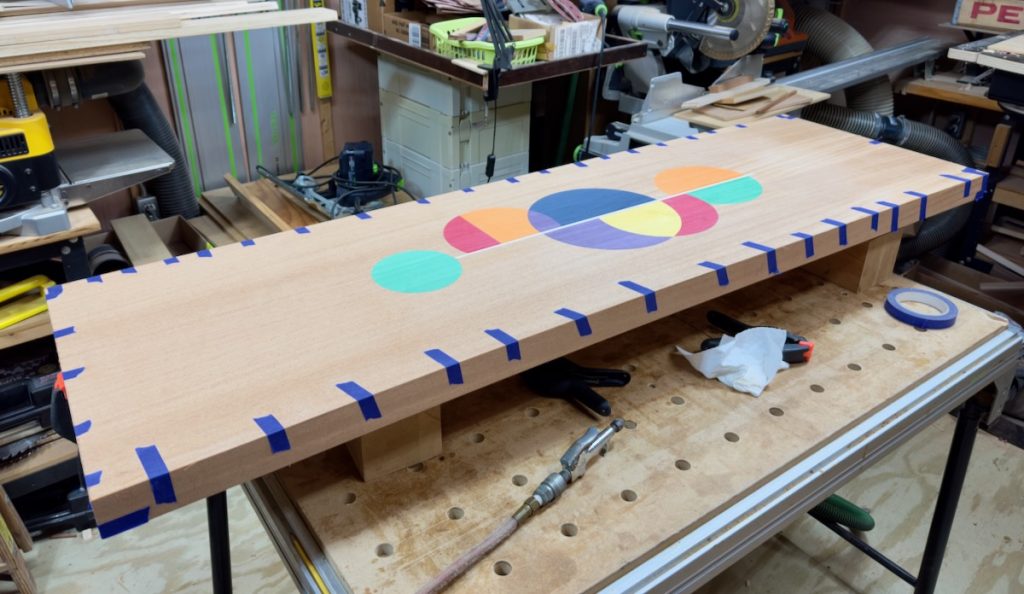
The edges are carefully cut to meet and then glued to the sides using tape.

The edges meet remarkably well.
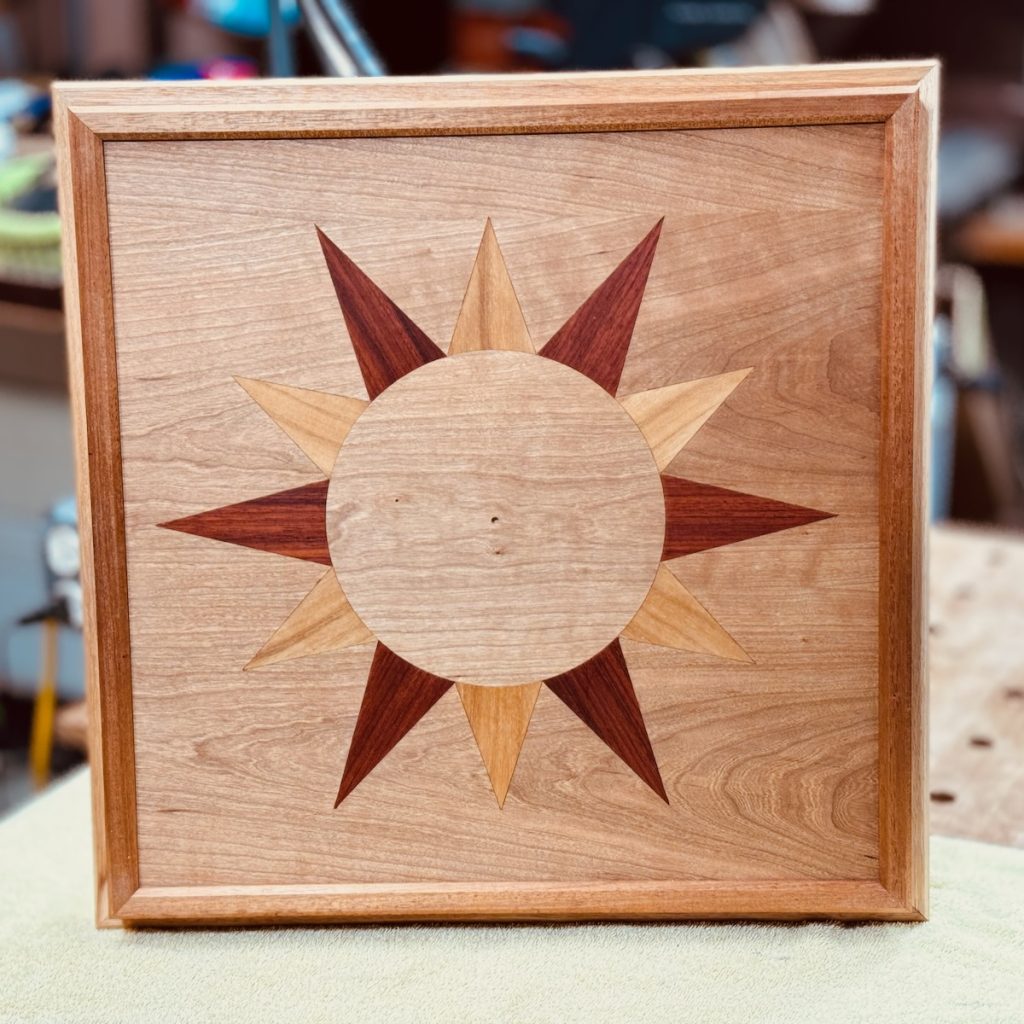
All the edges were glued to the top. The final step was to add a solid wood trim piece along the bottom and fit the underside with attachment points and a simple bottom panel of 1/4″ plywood. I carefully sanded all the panels up to 220 grit sandpaper.

I searched for and used a new finish when I finished my high-top table. It is called Rubio Monocoat and is a ‘Silicon Valley’ grade finish purporting a molecular wood bonding, so toxic fumes and similar cool stuff. I have been very impressed with how it has held up. They also recently introduced a final ‘sheen’ costing, which I used. The results were simply stunning!

Pure and Easy

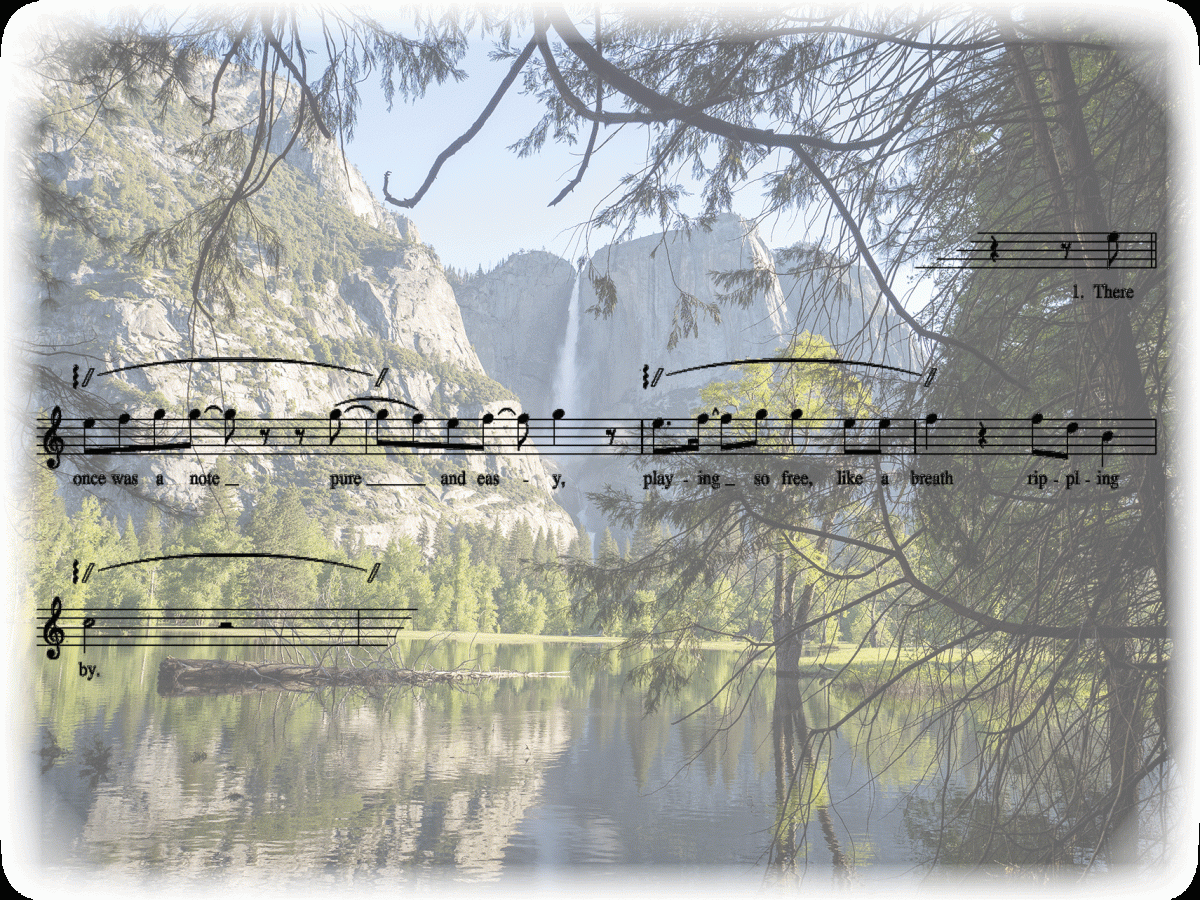
I still remember you. A phrase from a song by the Who floats through my head:

There once was a note
Pure and easy
Playin’ so free, like a breath rippling by

I remember your passion for that one pure and clear note. It showed in the things you like to do. I loved how you were always wanting to learn more and went about ways to achieve it. Searching and seeking…

You are the note

Thinking of you, Gail…

A Man and His Dog

An AI-Generated Fable

Once upon a time, there was a man who lived alone in a small house. He was mostly happy, but sometimes he felt lonely and sad. His dog, a loyal and faithful companion, was the main thing that brought him joy. The man loved his dog more than anything in the world, and the dog loved him back.

Every day, the man and the dog would go for walks in the park, play fetch with a ball, and cuddle on the couch. They would share their meals and secrets and comfort each other in times of trouble. They were happy and content.

One night, a fairy appeared in their room as they were sleeping. She was touched by the bond between the man and the dog, and she decided to grant them a wish. She said, “You two are the most loving pair I have ever seen. You deserve to be even happier. I will give you one wish, anything you want. But you have to agree on it, and you have to say it together. What do you wish for?”

The man and the dog woke up and saw the fairy. They were surprised and curious, but they trusted her. They looked at each other and thought about what they wanted. They realized that they had everything they needed except for one thing. They wanted to be more like each other, understand each other better, and communicate more easily. They wanted to be closer than ever.

They said in unison, “We wish to be father and son.”

The fairy smiled and said, “Your wish is granted. When you wake up tomorrow, you will be father and son. But remember, this is a permanent change. You can never go back to being a man and a dog. Are you sure you want this?”

The man and the dog nodded and said, “We are sure. We love each other, and we want to be family.”

The fairy said, “Very well. Good night, father and son.”
The fairy disappeared, and the man and the dog fell asleep.
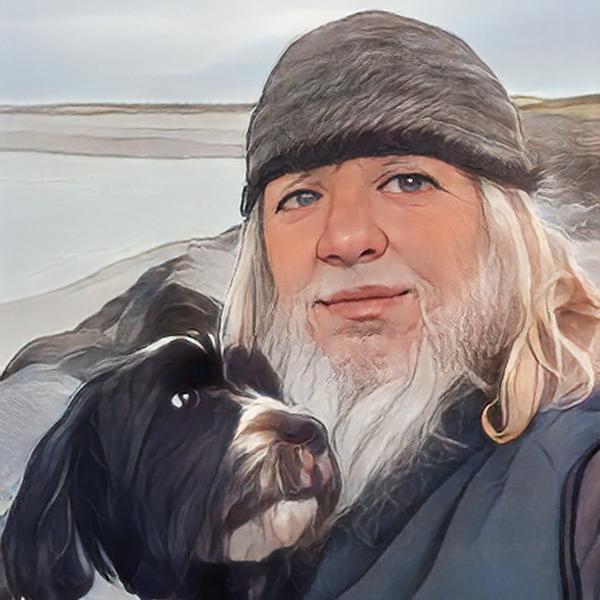
The following day, the man woke up and saw a boy lying beside him. He had black hair and brown eyes, just like his dog. He was wearing a collar and a tag with his name: Jake. The man realized that this was his son, his former dog. He felt a surge of emotion and hugged him.

The boy woke up and saw a man holding him. He had long gray hair and a long beard, just like his owner. He was wearing a shirt and pants with his name: Eddie. The boy realized that this was his father, his former owner. He felt a wave of affection and kissed him.

They looked at each other and smiled. They said, “Good morning, father. Good morning, son.”

They got up and went to the bathroom. They brushed their teeth and combed their hair. They went to the kitchen and made breakfast. They ate pancakes and bacon, and they drank milk and coffee. They talked and laughed, and they enjoyed each other’s company.

They went to the park and played soccer. They ran and kicked, and they scored and cheered. They met other children and parents, and they made new friends. They had fun and learned, and they grew and matured.

They went back to their house and watched a movie. They snuggled and cuddled, and they cried and laughed. They shared their thoughts and feelings, and they listened and understood. They loved and respected, and they supported and encouraged.

They went to bed and said good night. They hugged and kissed, and they wished and dreamed. They were happy and grateful, and they were father and son.

They lived happily ever after.

The end.


I commonly refer to Jake as my son. When I first met him some 7 1/2 years ago, he immediately went limp in my arms as I picked him up. To this day, he always lets me hold him and rarely struggles. We spend all our time together, and as the pillow says, I mostly speak to him throughout my day.

So, I asked an AI to write an original fable about a man who wishes his beloved dog was his son. With only a few edits, this is what it wrote. I have to say I am touched. But then I cry during my favorite TV shows and movies.

Freehand Routing

I became interested in woodworking at a young age. I think it was as much about the tools as the process of designing and building something you could point to with varying degrees of pride!

The first new power tool I got when I started graduate school was a router. I had picked up a couple of second-hand tools like a skill saw and a drill. I figured I could start doing some incredible woodworking once I had a router.

Wrong! I quickly discovered there are few things you can do with a router until you have other essentials, like a table saw. But more importantly, I learned there are only specific ways to cut wood with a router. I eagerly tried to create a simple nameplate with my initials, only to discover it was impossible to do anything freehand with a router.

I eventually became proficient at many operations using templates, a router table, and different fixtures and jigs. I could do things with high accuracy, but it involved a lot of setup work. It was tough to do small, detailed work. I was looking for an easy way to do inlay work without investing in CNC machines. These could do accurate work but were large and relatively specialized.

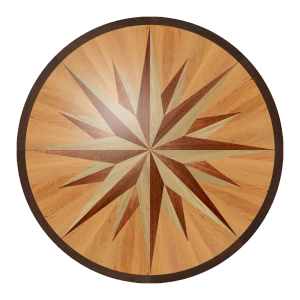
I had a project in mind to replace the top of the side table I built so many years ago in Colorado with a new one with a compass rose inlay. I had seen many examples of those done in wood over the years.

Then, one day, I noticed an ad for a new router showing up online. It is capable of precision-free hand routing using a camera system. I followed the ad to watch a video of a guy adding a compass rose inlay in the middle of the landing of a wood staircase. I pretty much bought it on the spot!

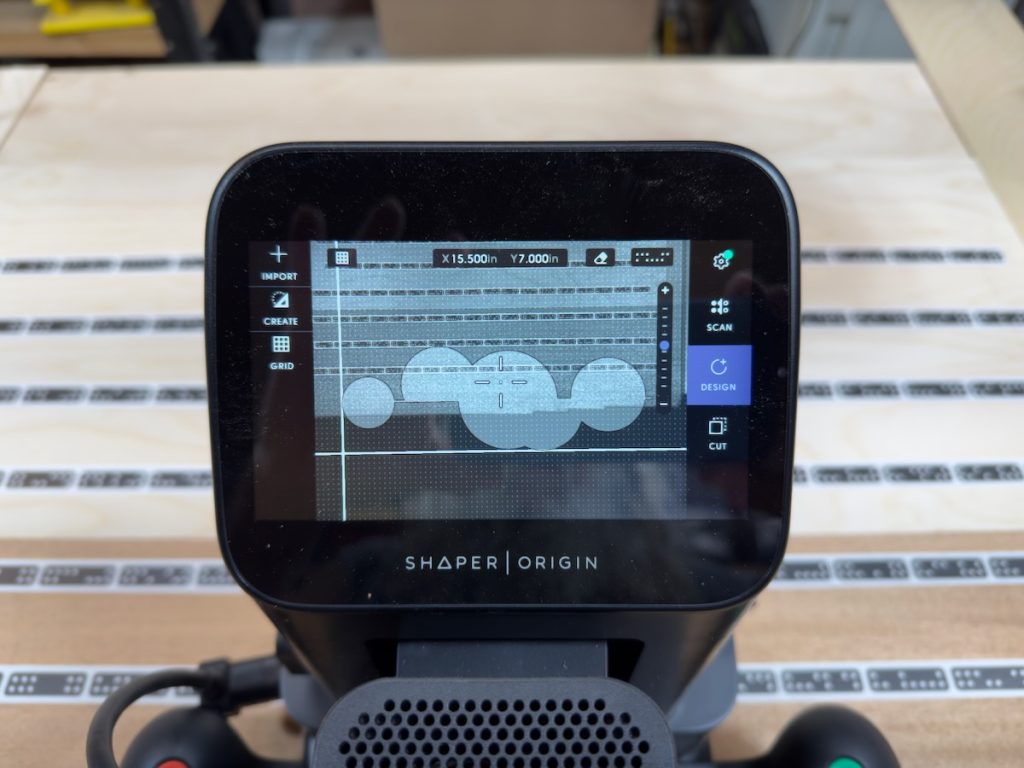
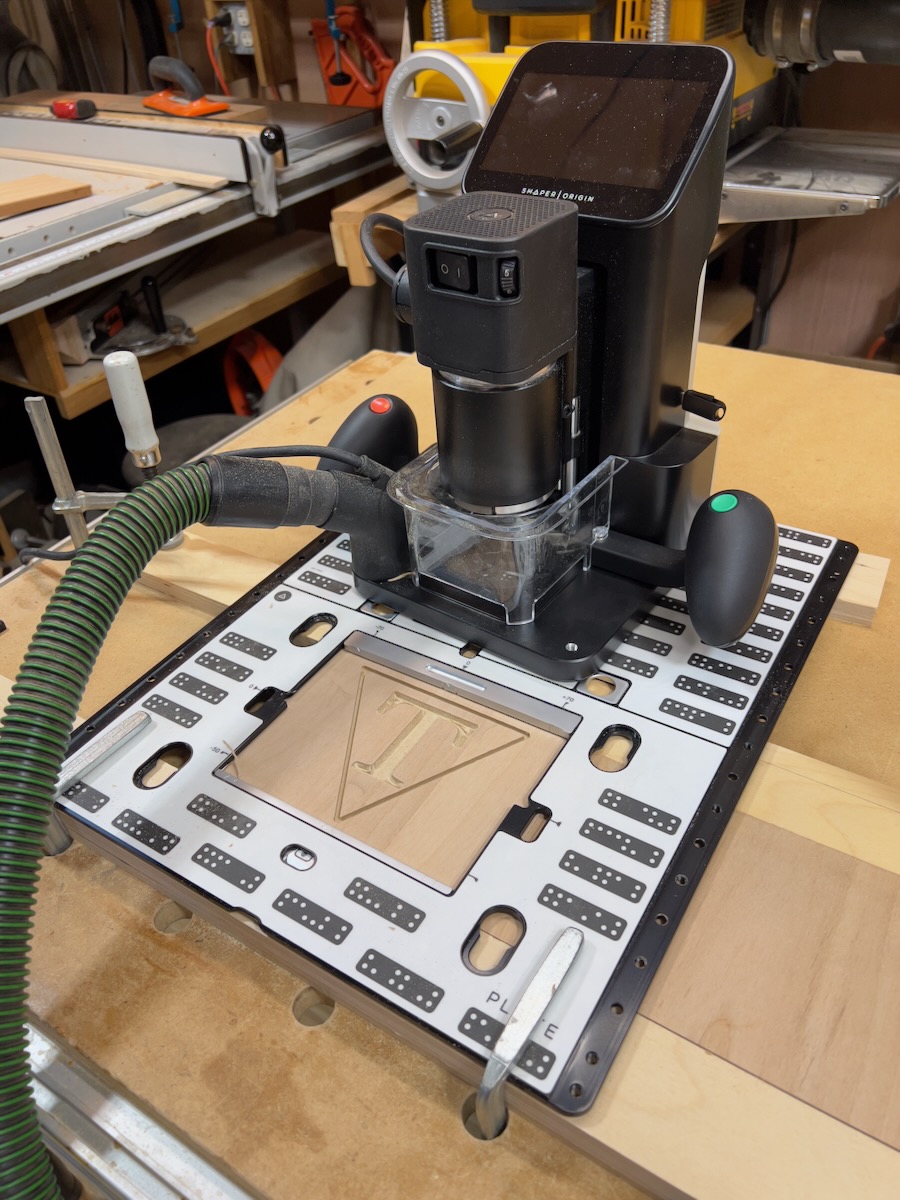
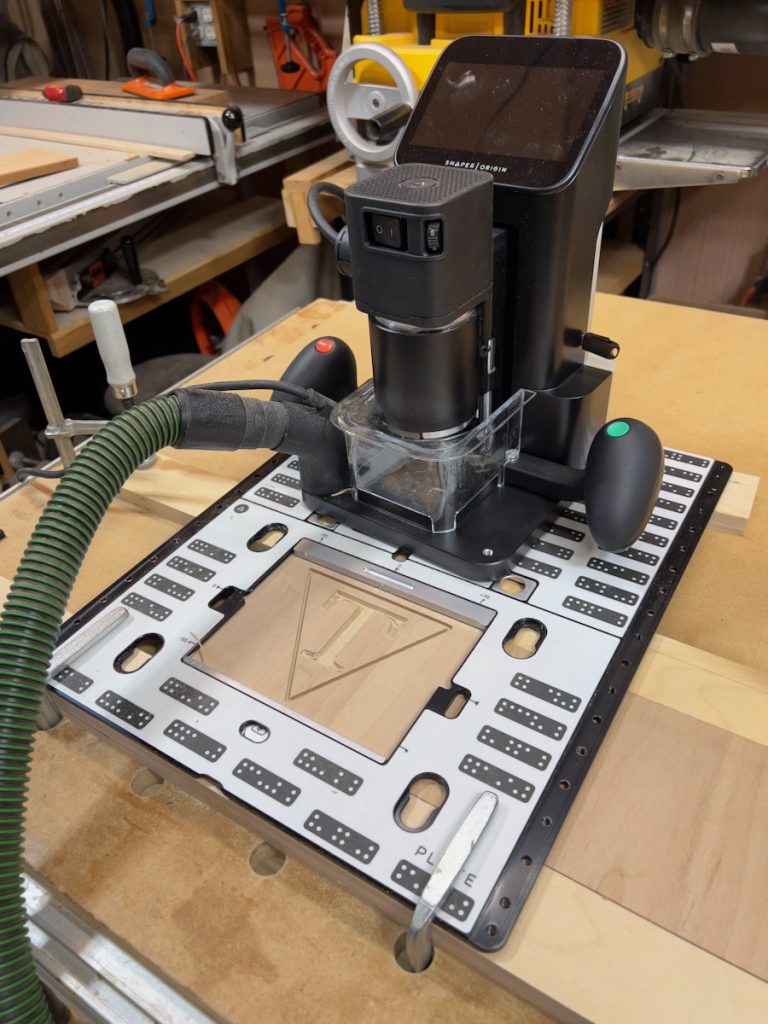
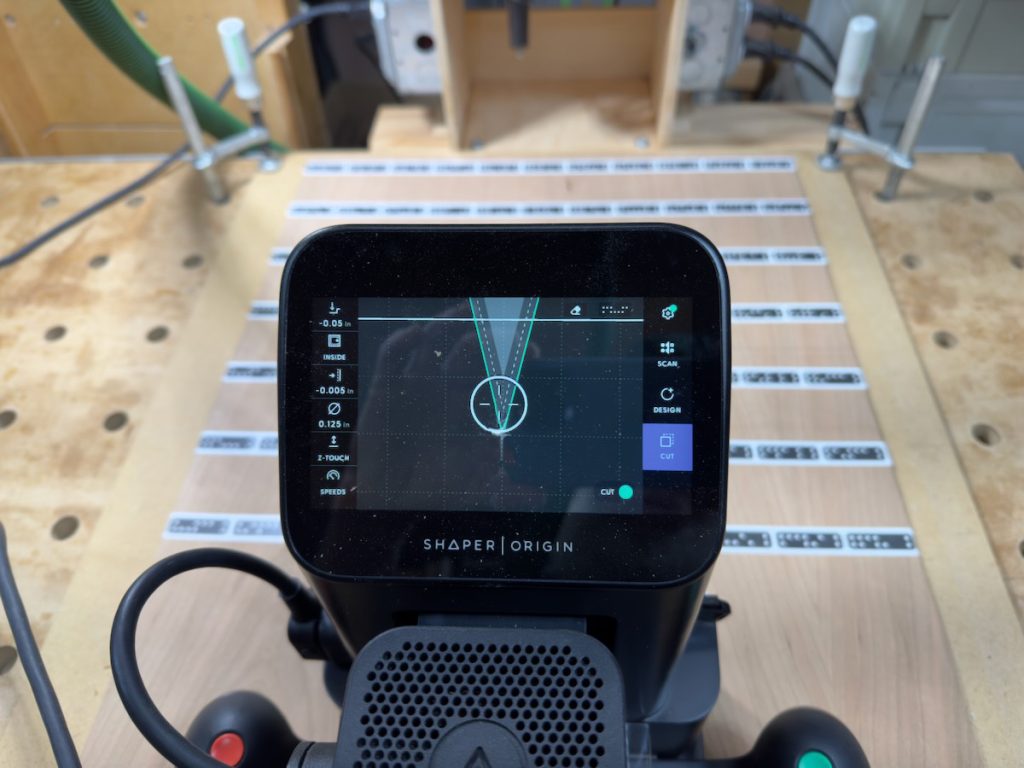
Essentially, a computer attached to a router with the ability to move the cutter head (parallel to the surface of the work) in real time. The operator follows a predefined path on the display while the camera looks at a pattern of user-applied graphical tape in the space above where the cut is being made. The motor is repositioned in real-time to ensure accuracy. The spindle instantly retracts if you move outside the track (roughly 1 inch in diameter).

The router is used with a positioning plate. The domino-like shapes are read by the camera on the front of the router to position the cutter accurately.

The system comes with several workstations with pre-applied graphics for common operations on small pieces. Tape is applied directly to the work for larger work so that the larger cut area can be accurately made.

It is absolutely essential the workpiece can not move relative to the positioning tape once the unit has been set up. Two-sided tape is used to keep the piece from shifting while being cut. You specify the cut depth, press the cut button to lower the cutter into the work surface slowly, and then follow and route the path. Effective on-screen graphics help guide the cut. Several cuts at varying depths are made to ensure smooth operation. The unit is heavy enough with a large smooth base and is easy to control when following the path on the display.

I am stunned at how accurate and repeatable the cuts are. Measurements can be entered accurately to one-thousandth of an inch. Offsets can be applied to provide for allowance on mating parts. Pieces can be cut and fit together like a jigsaw puzzle with stunning accuracy.

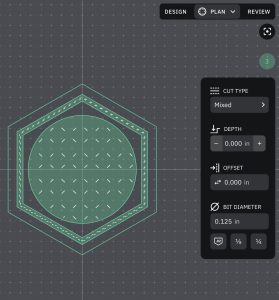
A web-based design tool can create tool paths for mortising and inlay work. It also can import AutoCAD files. I use AutoCAD to do my design work for my projects. Exporting design files and importing them to the tool was easy.

I would guess this will become a big hit. One of my favorite tool designers and manufacturers, Festool, from Germany, has already acquired the startup. I own several tools they made and have found them to be of exceptional quality and reliability and have held well over the years.

Fade to Years End

Jake and I spent the last part of the year at our Valhalla Beach Shack. Highlights included:


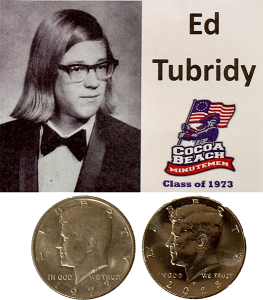
50th High School Reunion

Celebrating high school reunions over the Thanksgiving weekend is a tradition. This year was number ‘five-o’ for me. It was a lot of fun, and I talked with people I have not spoken to since then. Thanks to the cheerleaders – still at it these many years later – for putting it on.

I went with many of the people there for all twelve years! Like me, their parents were brought in for the space program. I fondly remember walking single file down to the beach to watch the launches πŸš€ with many of these folks. Interesting times indeed.


Meanwhile, back at the beach shack…

As immortalized on the album A1A released fifty years ago. RIP Mr. Buffett.

Oh Come All Ye Pastafarians! Ramen!

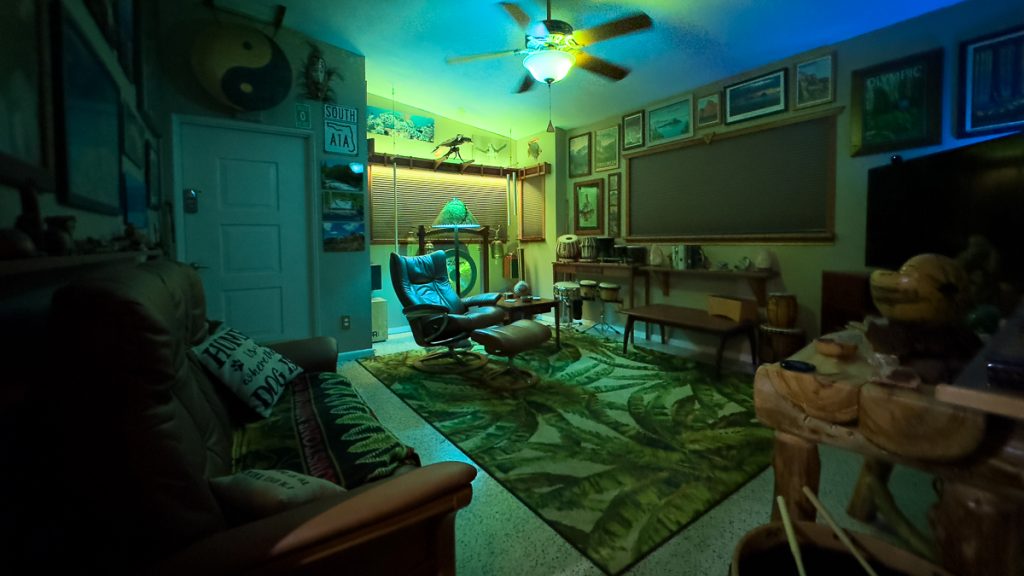
I finished the west wall of the living room to add some more mood lighting and a spot for my carved turtle.

A stroll downtown on Winter Solstice. Cool murals are everywhere now in our little tourist town.


Panama City Christmas Time

I spent Christmas with Dave & Lisa in Panama City. We got out in the boat several times, ate some delicious oysters, and feasted on Lisa’s culinary decadence!

Christmas Day Sunset over the Bayou


Falcon Heavy Night Launch

Elon and Co launch πŸš€ top secret spy space plan into high orbit on a spectacular 🀩 evening!


Fall into Winter Sunsets


Special Note: The Earth will be at its closest point to the Sun – Perihelion – January 3-4. The orbit varies by about 3% over the course of the year at roughly 92 million miles. Now you know 🧐

myNoise

I have been working on some videos from our recent Excellent Adventure. I use iMovie, which is quite good once you get the hang of it. It has a good library of sounds, including music, but they really do not fit my style.

At the same time, I have been hunting for a good audio source to accompany my drumming. I can produce drone-like sounds typical of the Didgeridoo on my electronic drums. I like that it provides a backdrop without forcing me into a set rhythm or tempo.

Finally, I have been sleeping with white noise for many years now. I found that playing the background noise in the house adds a very pleasant yet non-intrusive touch.

Along comes myNoise. It was developed by a Dutch guy who is really crazy about sounds. Travels all over the world, recording and collaborating with other like-minded people. The result is like the answer to my dreams.

Sample Indian Drone

There is a catalog of hundreds of different titles. Each title can be manipulated to add, remove, or change the level of different components of the sound with slider controls. The slider controls can be animated to change levels over time cyclically. Pitch can be accurately controlled. You can play multiple titles together to create combined sounds. It is truly a remarkable piece of programming.