After three days of traveling, our first stop was in the ‘Cavelands’ of Kentucky. This area north of Bowling Green has more known cave systems than anywhere else in the world 🌎. The largest is Mammoth Caves National Park. The area has a rich history of explorers and entrepreneurs looking for ways to capitalize on Mother Nature. It is also a beautiful horse country with rolling hills of green grass.
Horse Cave
Horse Cave KOA – Glamping, Camping & RVs (for the rest of us)
We stayed about 30 minutes from the national park at a campground in Horse Cave. As the sign says, it features camping and glamping—roughing it in style. They had an assortment of Tee Pees, Tree Houses, Covered Wagons, Cabins, and RV sites. There were lots for kids to do, including a slide and a giant jumping balloon.
I drove into Horse Cave proper to shop and take in the sights. Half the main street was torn up, with no apparent detours. I guess the locals knew how to do it. I found myself in a neighborhood with rotting trailers and large, vicious dogs. I did my shopping and got the heck out of Dodge 🤩.
Mammoth Cave is the most extensive mapped cave system in the world. The geological formations that enable this are a limestone layer (with the caves) underneath a sandstone layer (like a roof). This makes for a very stable formation.
Tourist guide printed in the late 1800s. The caves attracted international attention.
It has a fascinating history dating back over 5,000 years. Native Americans lived in and around the caves where many artifacts, including a mummy, were found!
The caves became an international tourist attraction in the 1800s. Ranger Eric told us that tourists from New York came in their Sunday finest to view the muddy caves. Remains of their meals can be found scattered throughout the caves.
In the early 1900s, the infamous “Kentucky Cave Wars’ resulted in shysters and conmen vying for the tourist trade. It seemed locals would go to no length to get the tourist dollars.
The rich Kentuckians decided to take matters into their own hands and prepare the way for it to become a national park. This process was especially contentious because it involved imminent domain. Thousands of people were unhappily relocated. (See the previous post on the Tennessee River Valey—no wonder people in this part of the country distrust the Federal Government.)
It finally became a National Park in the 1940s.
The total distance explored to date is more than 426 miles. The depth of the caves below the surface is between 400 and 800 feet. Explorers in the 1900s were able to determine the likelihood of a cave passage from surface features. These early surveys were hidden from general knowledge for fear of the caves not belonging to the landowners.
I was not disappointed when I embarked on the 4-hour Grand Tour. The tour truly lived up to its name, offering a grand experience of the cave system’s many facets. Ranger Eric’s expertise and engaging, folksy style of explaining the history and formations added a delightful layer to the experience.
A short bus ride leads you to the entrance for the 4-hour tour. The temperatures were cool but not cold, with an ever-so-slight breeze.
Despite my initial concerns about my 69-year-old knees and back, I found the route surprisingly manageable. The well-packed dirt, concrete pathways, and sturdy handrails made the journey a breeze. It was a testament to the cave system’s accessibility, reassuring me that physical limitations need not hinder such a grand adventure.
The first part of the tour winds through a passage created by flowing water.
The journey was indeed challenging, but the well-timed rest stops (two with bathrooms) provided a much-needed respite. The real thrill, however, was in the intriguing cave formations, particularly Boone’s Passageway. Its narrow spots and low ceilings added a unique and thrilling element to the adventure, making it an experience like no other.
The four miles were divided into three segments. The first was relatively open and level. The second took you through a tall and narrow section. The third featured towering staircases and areas where water formed stalagmites.
All in all, it was a stunning but exhausting experience! I felt a bit better meeting Bob at the end of the journey. He’s 80 years old and was my hero for the day!
Friday was a day off for shopping and recovering from the 4-mile walk. I was very sore and desperately missed my hot tub. Tomorrow, we raise anchor and head for St. Louis—Gateway to the West.
After a slight delay due to a major Oh-Shit, the Starship Excellent Adventure launches on the fourth installment of Jake & Eddie’s Excellent Adventure!
First Stop – Krystal
Many years ago, when I was but a pup, there was a Krystal Hamburger store in Cocoa Beach. The Krystal Experience, as I like to call it, is burned into my engrams. Originally, there was a counter where you could order food. Our mailman would eat breakfast there. You see, back in the 1960s, Krystal was well-known for their waffles!
He was a tank driver in the military. He told us how he would file down slugs and use them to buy cigarettes (I tried it later with no luck)! When we had our car accident at Third and Orlando, our car hit his Volkswagen Beetle and pushed it into the storefront of a cafe that was there (no one was hurt). These memories seem like a dream now. Maybe I made the whole thing up!
60+ Years of Krystal
Regardless, I always loved their crappy, grease-soaked hamburgers dripping with onions, mustard, and pickle slices on a square, fluffy white bread roll. If it ain’t broke, don’t fix it ~ indeed. It’s been my tradition when traveling the lower part of Georgia to always get me a sackful! Yum 😋.
Jake’s collection of puppys for the trip! Dino (from 2021) and Red (from 2022). Sluggo (from 2023) not shown. Plus his fav’s Santa Chop!
Cordele ~ Georgia
After a completely uneventful, mind-numbing drive north on I-75, we arrive at our first stop in bumfuck, Georgia. It thunderstormed all afternoon ⛈️.
Cordele Georgia or thereabouts 🤩
We left early, heading towards the dreaded Atlanta, the semi-truck capital of the South. After a short race on the USA’s largest raceway (aka I-285), we headed west on I-20 towards Birmingham. Then we took the backroads through northwestern Georgia, passing through Rome, to finally arrive at our next stop.
Leave It To Beaver
All Hail Mighty Beaver
In the book I recently read, Termination Shock, one of the main characters, T.R., is an oil billionaire who made his money off building enormous gas stations with dozens of pumps and a giant store to help travelers get rid of those cumbersome wads of cash (or more likely debit cards). He repents his sins of contributing to global heating now that his hometown, Houston, quickly going underwater by building a contraption to shoot sulfur into the upper atmosphere to cool the planet down.
All Hail Mighty Beaver. May the Beaver never go hungry! How fucking embarrassing is this stupid sign? For Spaghetti-Monster sake you mindless nitwits!
While this might just be a story, the gas stations are real – and called Buc-ees. Their mascot is a Beaver. Go figure.
Lookout $$$ Mountain
Lookout Mountain KOA
Our stop for the evening was near Trenton, Georgia. It is a very nice campground secluded in the rolling hills near the Georgia, Alabama, and Tennessee state lines.
Lookout Mountain KOA campground
Lookout Mountain area – beautiful views but hard to find because of all the damn trees 🌲🤣.
We took a frustrating drive through Lookout Mountain, looking for some views of the sunrise the following day. The only good view was on a section of the road up the ridgeway with no places to stop! We finally got to Rock City, expecting to see the views. They are there. They cost $31.
In the morning, we head from Chattanooga towards Nashville and then up to Mammoth Caves.
Tennessee Valley Rest Area – a river that is now a lake.
Whenever I see the Tennessee River reservoirs made during the 1930s by damming the river, I always think of the fantastic Coen Brothers movie Oh Brother Where Art Thou? Over 100,000 people were displaced when the dams were built. In the movie, the valley is flooded right before the trio – Pete, Delmar, and leader Ulysses Everett McGill – are to be hanged, thereby saving the proverbial day! Classic!
Booze It and Lose It in Tennessee!
I generally try to avoid going through the city. My RV safe navigator told me to give it a try. What the hell – what could possibly happen?
Power Lines with Nashville in the background. More crumbling infrastructure. Yee-haw!
I managed to get through with a moderate amount of frustration. One guy honked and gave me a thumbs-up, and another flipped me off for pulling in front of him 😎.
Guns and Ammo – Lots of signs like this. Hell, yes, I need more guns and ammo! Gotta get me a Libtard! Others told me I was going to burn in Hell—more performative warfare on display.
We arrive in the early afternoon. The campground is on the hill overlooking the Interstate on one side and this one on the other:
Horse Cave – looking west
One out of two isn’t bad at all!
Tomorrow: Jake gets to stay home while I explore Mammoth Caves.
I recently read Termination Shock, written by Neal Stephenson, one of my all-time favorite authors and futurists. It outlines how humanity could slow the effects of global warming and start reducing the mean temperature (e.g., stop the fucking ice from melting ape-like descendants). The impact of geoengineering on a geopolitical scale makes for an interesting read. Like Kim Stanley Robinson, Stephenson is very good at science and can develop truly unique (and somewhat believable) characters!
The book’s geopolitical aspects are more interesting than oil baron T.J.’s sulfur shooting canon, although it is pretty fascinating, too. Other characters include the Queen of the Netherlands and a Sikh Gatka fighter from Canada! Most specifically, his concept of performative warfare helped me understand the state of my country that I hold dear, being torn apart by violent-tinged rhetoric.
This aggression will not be tolerated, man!
Here’s some interesting stuff I learned.
Rising water
The past few Hurricane seasons can be summed up like this: Storm Surge. Why? Low-lying areas are more subject to flooding now.
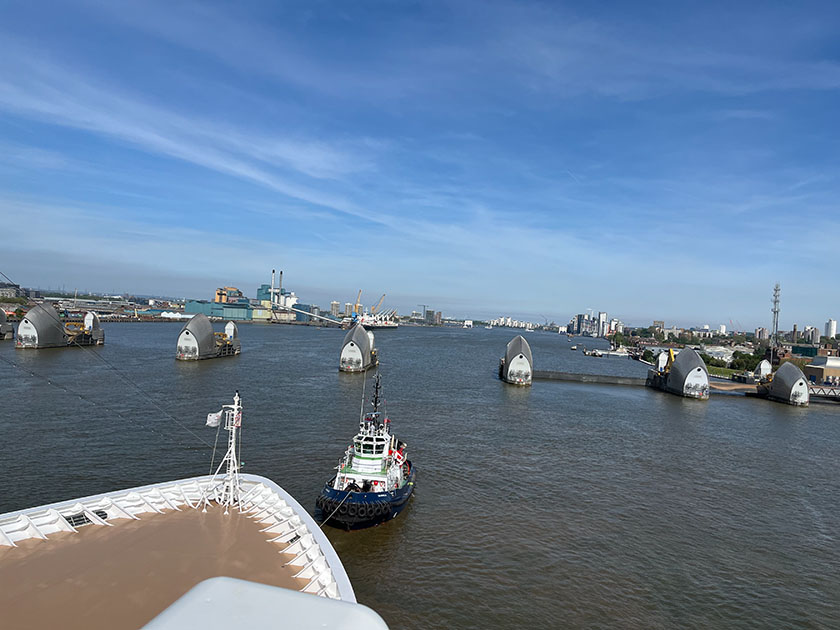
Brother Rick took an amazing picture on his recent cruise around England. It’s a shot of a engineered barrier on the Thames river designed to reduce the effects of flooding.
The Thames Barrier is a retractable barrier system built to protect the floodplain of most of Greater London from exceptionally high tides and storm surges moving up from the North Sea. It has been operational since 1982. When needed, it is closed (raised) during high tide; at low tide, it can be opened to restore the river’s flow towards the sea—source Wikipedia.
I remember visiting Holland in the late 1980s while living in Europe. I remember being there over the weekend and touring the countryside. At one point, I drove out to the coast. As I approached the coast, I saw these very large structures in the distance. These were the dykes holding back the north sea.
Somewhere on the coast of the Netherlands. The Netherlands means “lower countries” in reference to its low elevation and flat topography, with 26% situated below sea level—source Wikipedia.
In fact, at that time, they were just starting on the design and ultimate construction of the largest man-made movable object in existence today. The Maeslantering closes the mouth of the channel leading into Rotterdam. A computer is used to predict storm surges that could threaten to flood upstream. It does this automatically. The first time it was set off was 2023.
The Maeslantkering (“Maeslant barrier” in Dutch) is a storm surge barrier on the Nieuwe Waterweg in South Holland, Netherlands. It was constructed from 1991 to 1997. The barrier responds to water-level predictions calculated by a centralized computer system. It automatically closes when Rotterdam (especially the Port of Rotterdam) is threatened by floods—source Wikipedia.
In the story, T.J.’s hometown of Houston is constantly under siege from stormwater. (I worked with a woman at IBM whose parents in Houston had their whole first floor flooded in the late 2010s.) He makes a rather dubious claim that the rich would pay to mitigate the effects of rising temperatures because their land was so valuable. Maybe not, but it’s an excellent idea 💡.
Sea Foam
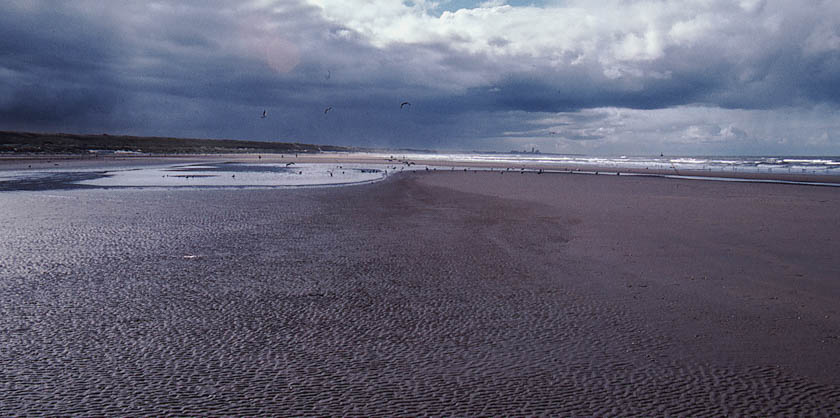
I remember seeing a beach that went out what seemed like a thousand feet at low tide.
The coast of The Netherlands circa late 1980s
The story contains an incident based on one that actually happened in 2020. Five Dutch surfers were inundated by sea foam pushed in by strong winds and an algae bloom.
We regularly have those in our canals here caused by fertilizer runoff. Fish die by the scores. According to a government website, Scientists know that certain environmental conditions, such as warmer water temperatures in the summer and excessive nutrients from fertilizers or sewage waste brought by runoff, trigger HABs, but they are still learning more.
Sulfur
It turns out sulfur is cheap. It is often the by-product of mining and petroleum distillation processes. Sour Oil contains a lot of sulfur that costs way less than purified crude oil, so it is readily available. It can also be dispersed into the upper atmosphere as sulfur dioxide. The effect it has is stunning.
In the late 1990s, a massive eruption occurred in the South Pacific. This has happened before but has never been studied as thoroughly due to advances in various technologies and programs dedicated to studying the climate. One of the results led to a dramatic conclusion: sulfur dioxide from the eruption was detected at altitudes above 80,000 feet. From science, we know that sulfur dioxide at the altitude reflects sunlight back into space. The effect was lower temperatures in the area of dispersion for several years.
Like carbon capture, a more commonly heard buzzword, intentionally burning sulfur as it is shot into space is a concept of geoengineering. One can only imagine the consequences of radical climate change if it affects some areas adversely to the advantage of—let us say—a country facing severe flooding and hardships like The Netherlands from ever-increasing global temperatures.
In the book, an Elon Musk type develops a way to shoot sulfur into the atmosphere. He makes a questionable argument that if it can hold back the inevitable flooding, rich landowners would foot the bill because their land is so fucking valuable. Some of them that are now perhaps arguing it’s all bullshit. This is an example of snapback.
Papua, Niugini, Niu Gini
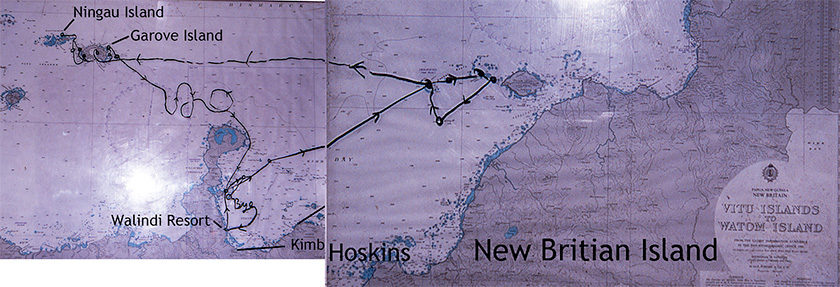
In the late 1990s, I went on my most incredible adventure. My dive buddy Dan and I journey over several days and stops to arrive on the island of New Britain. Situated on the southeastern part of the Bismarck Sea, it is one of many islands called Papua, Niugini, or Niu Gini by the natives and New Guinea by the Western world.
Route of our dive boat Star Dancer in the Bismarck Sea in Papua New Guinea
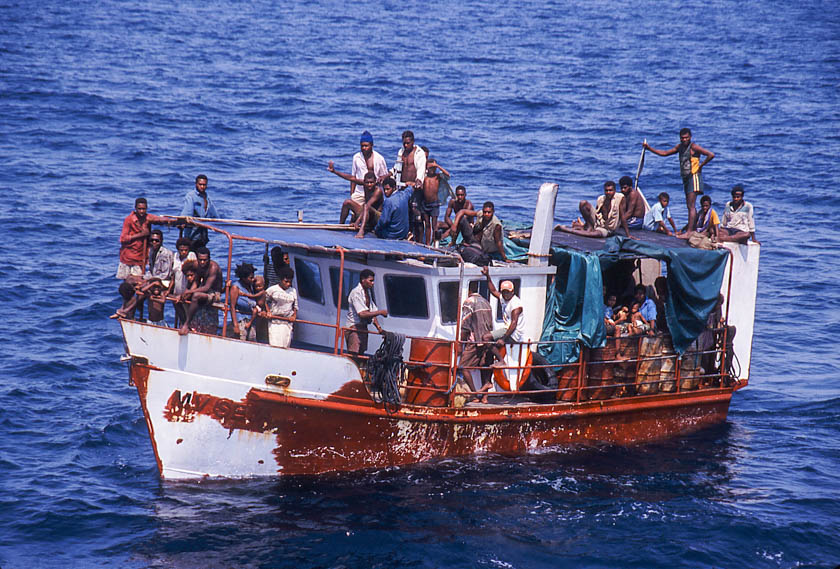
The natives at the time we visited seemed to be in dire straits. We came across a boat overflowing with natives adrift in the Bismarck Sea. Who can imagine the life they must have had?
Locals adrift in the Bismarck Sea
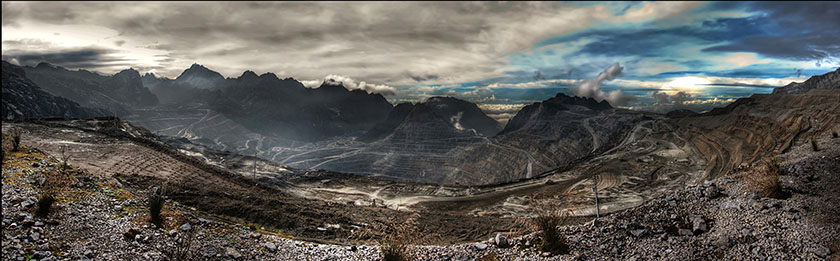
The book discusses a huge mine on the main island. Situated 14,000 feet above sea level, it contains enormous reserves of copper and gold.
The Grasberg mine has one of the world’s largest reserves of gold and copper. It is operated by a joint venture between the governments of Indonesia and Papua and the American company Freeport-McMoRan (FCX). source – Wikipedia
The mining operations have severe environmental consequences. The geopolitical consequences are even bigger, mixing old colonialism (The Netherlands), new colonialism (Indonesia), and a severely repressed local population indigenous to New Guinea. This last group had a distinct reputation for eating their enemies in the past.
In the book, the oil baron T.J. turns it into another site for shooting sulfur into the atmosphere. Sulfur, it turns out, is oozing from the slurry processed at this site. Basically an ecological disaster.
Lots of people are not happy with this. It turns out the copper is required to make all these ‘green’ wind turbines in Europe. People in the Punjab are pissed off because the monsoon didn’t start on time. The Queen of the Netherlands is concerned. Hilarious mayhem ensues as the Sikh Gatka fighter takes on Red and the eagles and falcons trained to take out drones.
Snapback
Another interesting aspect explored in the book was the concept of snapback. What is snapback, you ask? It’s when a person or a group of people with a common interest suddenly changes their long-held position. Why? Snapback.
Watching movies and television shows from the 40s and 50s is always interesting. Everybody except the kids is smoking. Doctors were paid to promote brands or say smoking was safe and provided benefits like calming your nerves.
Snapback: When it became obvious that smoking could kill you, this stopped, and you couldn’t find a doctor in your right mind who promoted it. It was certainly clear to them all along this wouldn’t end well.
Oil companies face the same, if not worse, dilemma. I do not doubt that they understood the consequences of burning fossil fuels. But the benefits far outweighed the consequences. The car companies, who relied on this to fuel their automobiles, were in a pickle.
Snapback: We apologize for participating in the destruction of our environment. Here, have an electric car. It’s green—well, except for the batteries. And you need really expensive tires that don’t last very long and get dumped into a burning landfill.
Amazing bullshit. Saving the environment is all about economics. When it becomes profitable for companies to do it, they do it, and their performative response (see below) is the result.
Performative War
I found this topic of immense interest. It tied a lot together in my attempt to make sense of this incredibly fucked up world I find myself living in.
First, a passage from the book:
Question: “It’s an asset, you’re saying? The sheer incompetence of the United States?” Reply: “People have come to rely on it.”
Performative acts or behavior are intended to show how a person wants to be seen by others rather than who they really are. Performative behavior is defined as an action taken specifically with an audience in mind to elicit a response or reaction. In other words, it’s living for the likes 👍.
Branding Aggression
If you extrapolate this to the concept of warfare, it becomes more like what Israel, Russia and China are doing now in their respective territories. They are not only taking action that costs lives but doing it in a manner that tries to elicit a specific response. In the other world, swaying public and political opinion to a certain goal supports its position, although widely rejected by the other side.
Watch it on YouTube! Recommended by influencers such as Matt “Rapey McForhead” Gaetz.
And then there is our own L’homme qui est Orange. Thirty-four counts of white-collar crime easily passed off as a weaponization of the judicial system to prevent their candidate of choice from representing their views – whether it be White Christian Nationalism or sheer Fuck You Lib-Tard. It’s so painfully obvious that it’s not their reality; it’s mine. Your truth isn’t mine, buddy, and I got lots of people that agree with me, so fuck you. I would shoot you on sight, given the choice.
35 nights ~ 4600 Miles ~ Mammoth Cave & Natural Hot Springs National Parks ~ Family & Friends
I originally planned to visit Nephew Carl and his family in Wisconsin in 2022. My knee surgery threw a monkey wrench into that plan. We will visit them on this trip, drive through America’s Heartland, and visit some “bucket list” National Parks.
Gradually Northwest to the Heartland
We will start our trip by visiting the Horton family cemeteries in the western part of Virginia. My father’s mother came from early English immigrants who saw the American Revolution and the Civil War. Evidence shows that the family name can be traced to a landowner, Horton, in the 12th Century. They lived near Cumberland Gap – home to Daniel Boone and very early childhood memories of reenactments by the fireside.
We will visit childhood friends who settled on a beautiful TVA reservoir outside Knoxville, Tennessee. We stopped there two years ago on Excellent Adventure 2022.
A tour group gathers in Star Chamber on the Violet City Lantern Tour at Mammoth Cave National Park in Kentucky.
From there, Mammoth Caves National Park (outside Bowling Green, Kentucky) will be our first of two National Park visits.
We then head towards the mighty Mississippi River at St Louis. We’ll stay two nights there before starting the trip north, following the river as best we can, before arriving in La Crosse, Wisconsin. This will take us through Illinois, Iowa, and Wisconsin.
The Heartland
I have always associated the heartland with Scandinavian origins. I spent some time there in the 1980s and loved their style!
We also look forward to seeing nephew Carl, Dr. Kari Bringe, and the “Norwegian to the Core” Bringe Family. They are my perfect vision of America’s Heartland as a multi-generational (successful) farm family.
Clan Tubridy & Clan Bringe – Fall 2021 – La Crosse, Wisconsin
Driving through Minnesota, our next stop will be in North Dakota. We will visit Sister-In-Law Myrha’s brother and sister-in-law in the middle of a wheat field! I met them once many years ago. They are woodworkers, and I would love to see their setup in the Heartland. It also gives me an excuse to drive all the way from the farmland of the Mississippi River valley to the Great Plains before they drop southwards.
The Road to Nowhere
Drive to Nowhere
I saw a route on a map that listed 10 great drives. The Drive to Nowhere was one, following a route just west of our chosen route! They say this is the truest path through America’s Heartland.
It will take five days to reach our next National Park stop, Hot Springs National Park, outside Little Rock. Along the way, we will stop in Sioux City, SD; Omaha, NB; Kansas City, KS; Joplin, MO; and Sallisaw, OK.
Hot Springs National Park, Arkansas.
At the end of this journey, I will complete the milestone of visiting all 50 states at some point in my nearly 70 years on this beautiful planet I have come to love so much. The only state missing was Nebraska! I landed there once to catch another flight, but I don’t count airport only stops!
The Road Home
From there, we wind our way home, stopping in Louisiana, Mississippi, and Alabama before returning to our little beach shack on the ocean.
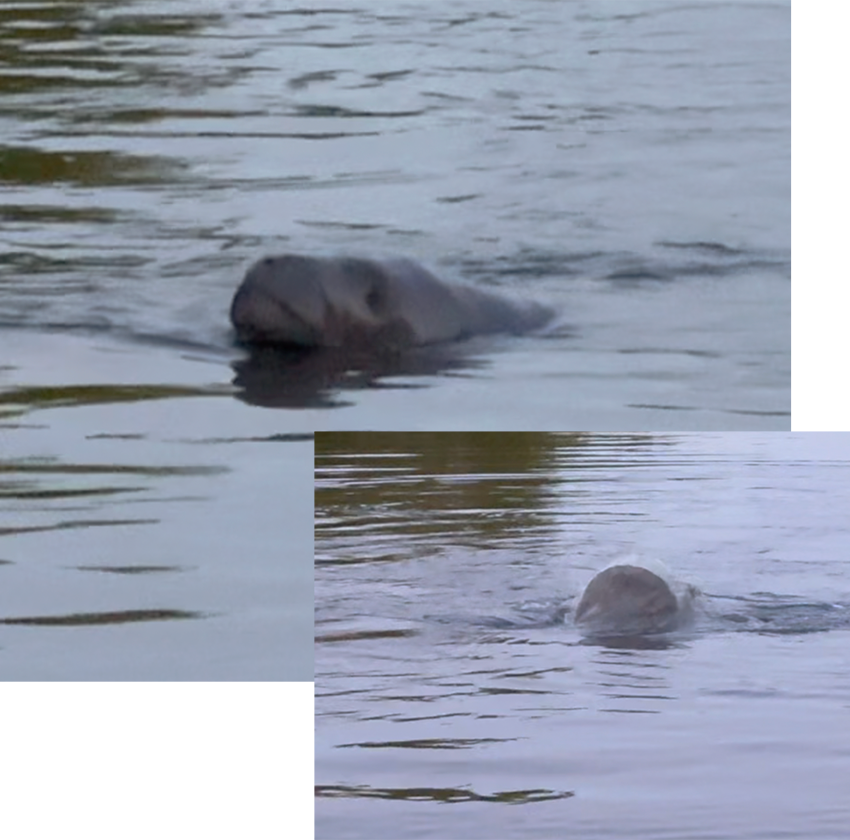
Spring is here, and the animals are a humpin! We spotted these manatees at Ramp Road Park. It was hard to tell, but my guess is that there were more than two of them.
This is the second time I was in the right place at the right time to witness this. After I moved to Florida, I spent a lot of time kayaking with my dog Sam. We stumbled across another sighting in the Thousand Islands on the north side of Minuteman Causeway, the islands of my youth.
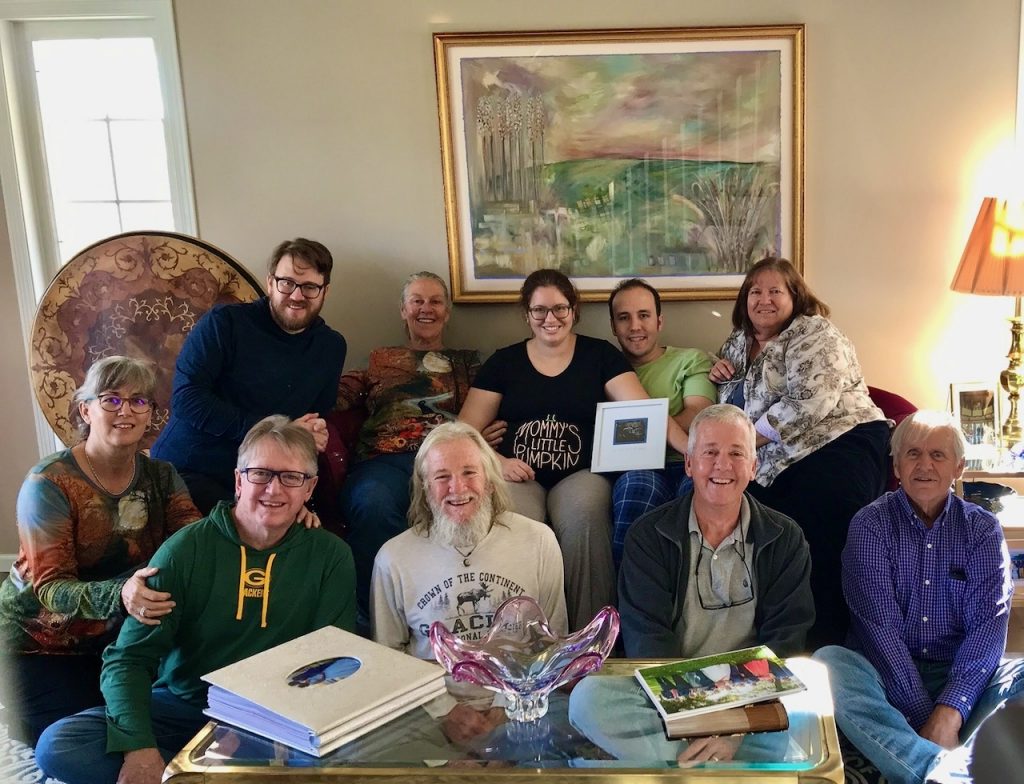
Most of the family, including the three brothers, the two sisters-in-law, Carl and Kari, and the gem of the Tubridy clan—Theo—came for a visit. Highlights included a celebration at Rick and Myhra’s palatial estate in Rockledge and a stop at Valhalla so Theo could hit the skins.
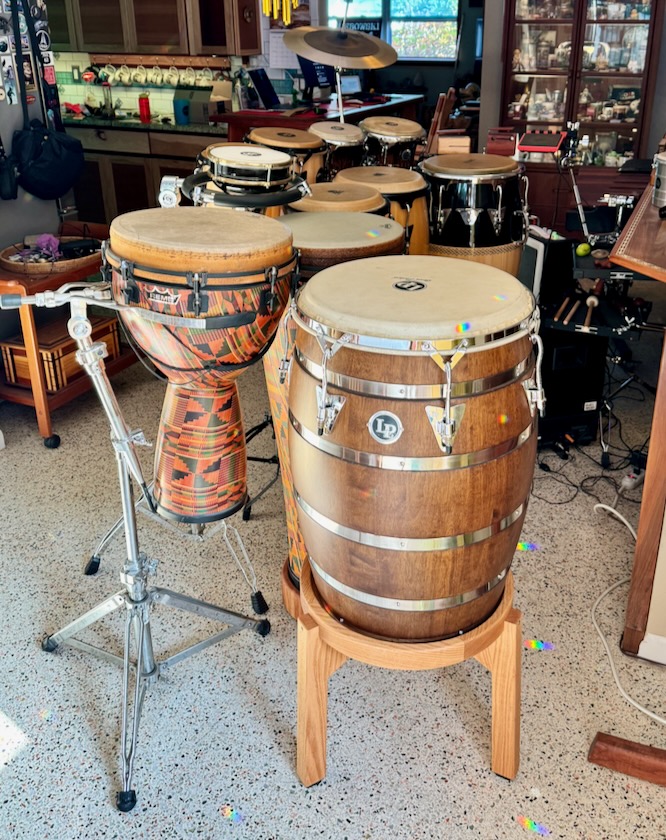
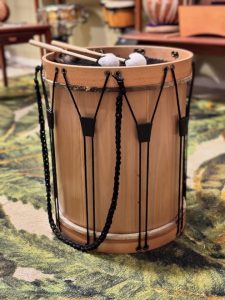
I recently added a very cool hand drum to my ever-growing list of things to hit. LP (Latin Percussion) recently added it to their so-called ‘world percussion’ line of instruments.
The term Bombo applies to a broad range of large drums derived from the European bass drum, often played by large orchestras’ percussion sections. The specific make of the instrument depends on the regional tradition.
The drum is a beast, and I had to make a heavy, custom stand to bring it to the playing height of my other drums. It has a natural 16-inch drum head secured like a traditional conga drum. The head is so big that you can get a rebound like playing with sticks! The tonal differences between the three traditional types of strokes—slap, open tone, and marcha—are superb!
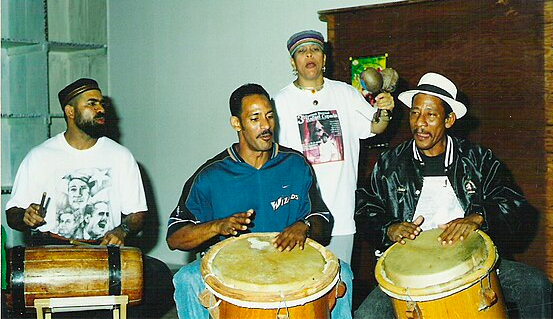
Puerto Rican musicians play Barril de Bombas.
More accurately, this is called a Barril de bomba and comes from Puerto Rico. It is meant to be played sitting down with the drum tilted forward while playing. Two are used in traditional music from that region, one playing a constant beat while the other plays over the rhythm.
Bombo legüero 🪘
This was actually my second Bombo. I’ve had the first one for a while now. It is very different than this one. It comes from Argentina, has a horse-hide head (complete with fur), and is tuned with a rope. More accurately, it is called a Bombo legüero. It is the traditional bass drum in music from that region. It is played with beaters and has a very low, muffled thud when placed. It also looks great in my living room!
Merkaba, also spelled Merkabah, comes from a Hebrew word meaning chariot or vehicle and can also be defined as light, spirit, or body. The origin of Merkabah is attributed to the Old Testament prophet Ezekiel, who described his vision of the throne of God, or Merkabah.
Mythology
The Merkaba Symbol is a shape made of two intersecting tetrahedrons that spin in opposite directions, creating a three-dimensional energy field. Hidden within these combined tetrahedrons is the whole divine self and divine knowledge. The star tetrahedron is a 3D representation of the Star of David. This shape is believed to be a tool to aid us in merging with the Source, helping us connect our ethereal and physical bodies.
The Merkaba is a powerful protection tool for light-seeking and deep healing. According to its description, “From helping activate your third eye chakra to encouraging you to access higher dimensions and embrace unconditional love, there’s a lot in store for those who welcome the Merkaba star into their lives.”
Wow!
Merkaba Crystal
Crystal Merkabas are made of pure Quartz Crystal. According to Gongs Unlimited:
“Mer” means Light, “Ka” means Spirit, and “Ba” means Body.
Merkabas represent the spirit and body surrounded by fields of light that transport energy from one dimension to another. Each combines and embodies the raw elemental and spiritual power of Quartz and the Merkaba.
Quartz has long been sought after for its spiritual and energetic healing qualities. It is known to have Piezoelectrical properties. Piezoelectricity is an electric charge that accumulates in crystals in response to applied mechanical stress, like pressure and heat, which converts into an electric charge. Clocks, record players, and all kinds of other technology have used piezoelectric crystals. Crystal healers use them to help regulate and balance their spiritual energy and EMF field.
When used in meditation, a Merkaba-shaped crystal enables one to experience expanded awareness, connect with one’s Higher Self, and achieve elevated states of consciousness.
I love to read, but not all the time. I often stop reading, especially when I can’t find anything new and exciting in my genre: Science Fiction.
I started obsessively reading in college and continued for many years after that. I read all the greats, including Frank Herbert’s Dune (my all-time favorite) and works by Auther C Clarke, Issac Asimov, Larry Niven, Michael Crichton, Kurt Vonnegut, and Dan Simons. I was always searching for new authors and stories.
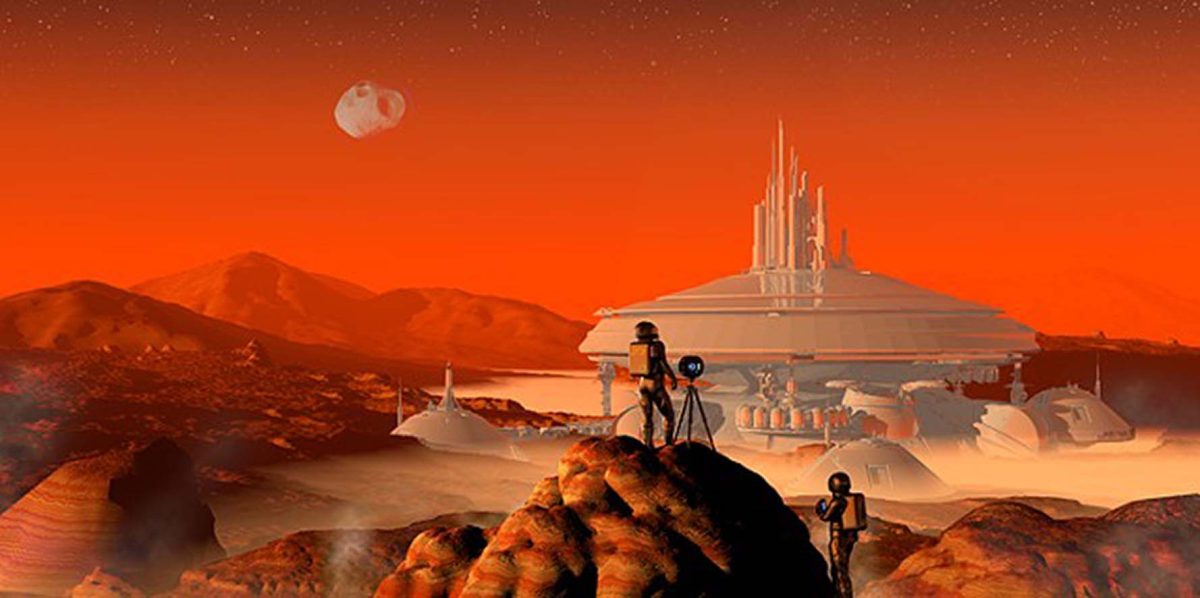
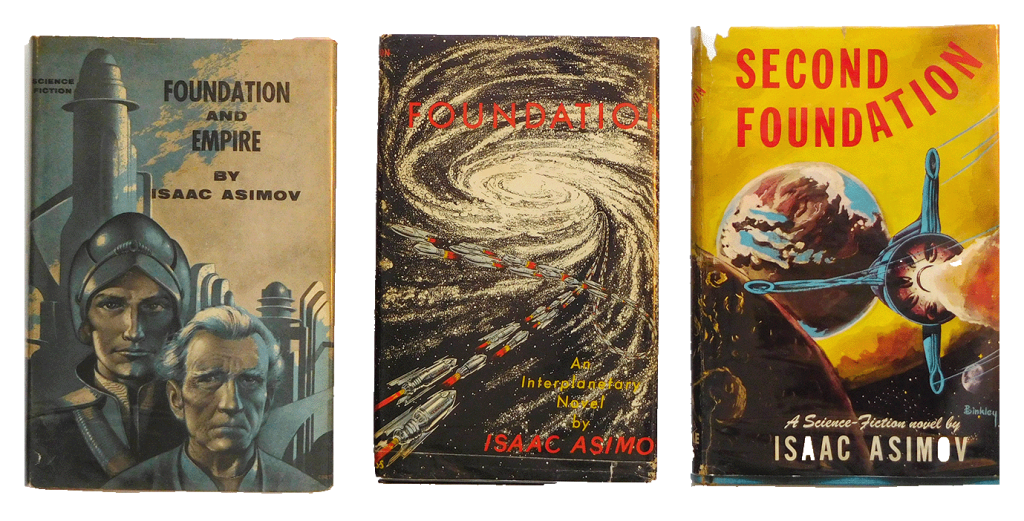
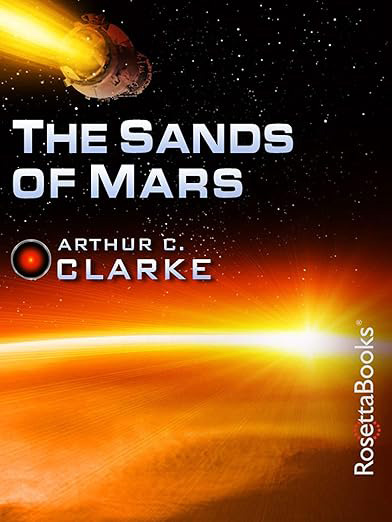
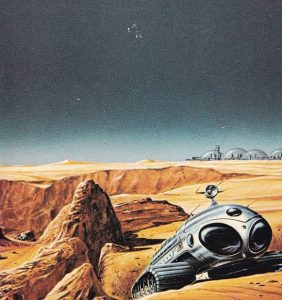
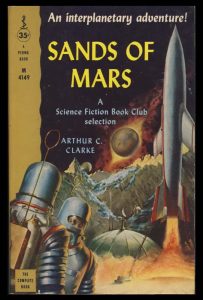
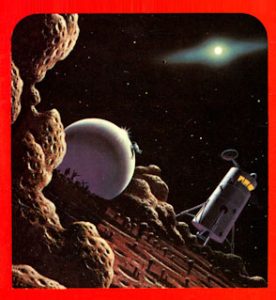
The oldest sci-fi book I have read up to that point was Asimov’s Foundation in 1951. It was the original space opera and took place somewhere a long way away in the future. I recently found one of Clarke’s earliest books, Sands of Time. It was one of his first published novels and describes the colonization of Mars from the point of view of the early 1950s. I found it fascinating and, at the same time, not a great story.
It’s taken me over three months to read the book, but I am determined to finish it!
The story is straightforward and perhaps prophetic for Clarke: A famous science fiction writer is offered a trip to Mars on the first interplanetary tourist spaceship. It’s a stunt to get him to write cool stuff about Mars and bring in the tourists.
Mars is a thriving colony at this point. The Mars envisioned had vegetation and canals. They discover some weird living creature before the story is over. Interestingly, this is how people thought Mars was in the 1950s.
Clarke’s vision of Mars was based on what was known or imagined in the 1950s. The Martian canals were long discredited, but Mars did not have mountains or craters. Seasonal changes visible from Earth were thought to be caused by vegetation of the sort the novel describes.
It led one reviewer to write:
In The Sands of Mars, Clarke addresses hard physical and scientific issues with aplomb—and the best scientific understanding of the times. Included are the challenges of differing air pressures, lack of oxygen, food provisions, severe weather patterns, construction on Mars, and methods of local travel—both on the surface and to the planet’s two moons.
Some of the technology described had not changed since the 1950s. For example, carbon paper and typewriters are used on the interplanetary ship, and cameras have film. Smoking and drinking during the journey are the norm. The white male-oriented social structures (good old boys) are similar to what Clarke wrote. While a woman engineer is mentioned, most of the females on Mars are assumed to be secretaries or receptionists. The only names given in the book are of European derivation.
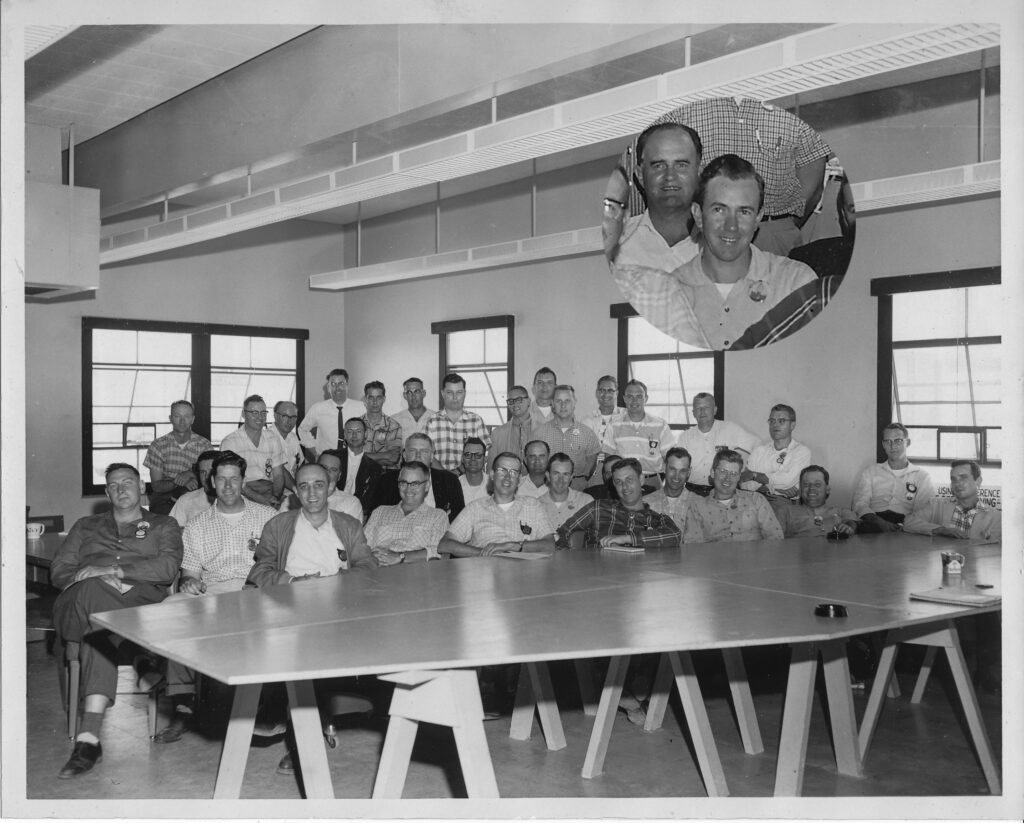
The Convair team, including my father, at Pad 14, worked on an early Atlas launch in the late 1950s. They called themselves bastards in jest! The heady days of the early space program.
Manifest Destiny? – perhaps a touch. It is the final frontier, after all.
In recent years, I have turned to star gazing. I am particularly fascinated by how the Moon, planets, and stars move through the sky. The Moon, in particular, never seems to be where I think it should be or oriented the way it is!
Today is a very special, interesting day. For the longest time, I thought that the extra day added every four years was to account for the fact that there are approximately 365 1/4 days per year. So 4 times 1/4 is equal to one day. And since it’s not exactly 1/4 of a day, we skip the extra day every 400 years.
Sort of….
It turns out the real story is much more complex and interesting! I recently read an article in Big Think about what a day and year actually mean in terms of Earth’s orbit around the Sun and the influence of the Moon on Earth. It points out how this has changed over the millennia. For example, days last only 6-8 hours during the early days of the earth!
Rotating While Rotating
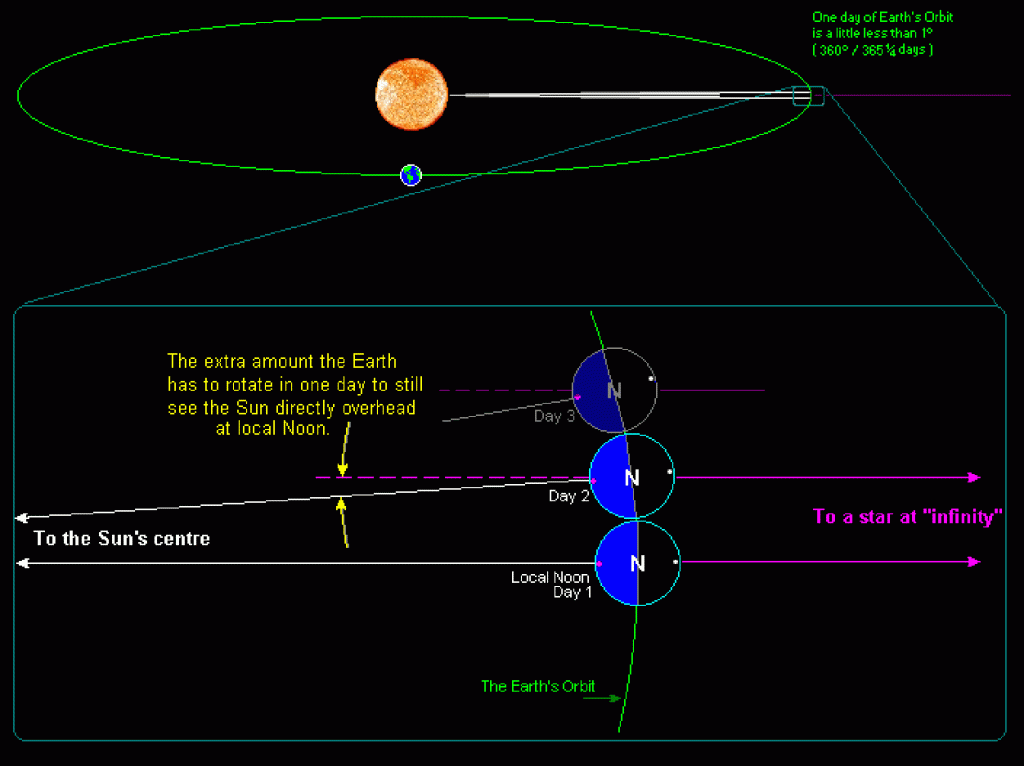
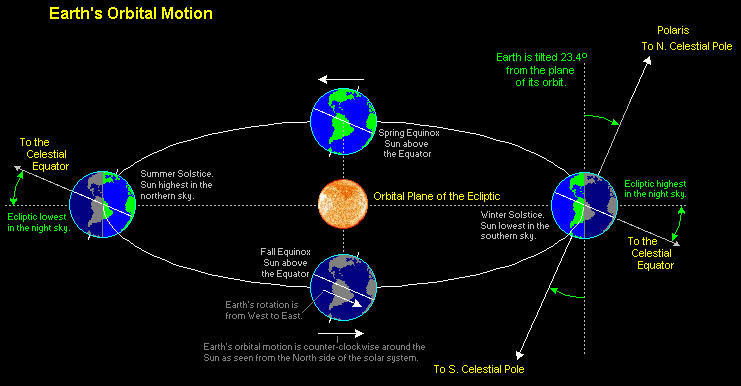
As the Earth rotates daily, it is more slowly circling the Sun. This introduces a variation when the Sun peaks during the day. The result is that what we perceive as a ‘day’ from the Sun’s position is a little longer than it takes for Earth to complete a complete (360-degree) rotation (23 hours and 56 minutes and 4.09 seconds)
To travel once around Earth’s orbit in a path around the Sun is a journey of 940 million kilometers. The extra 3 million kilometers that Earth travels through space per day ensures that rotating by 360 degrees on our axis won’t restore the Sun to the same relative position in the sky from day to day. This is why our day is longer than 23 hours and 56 minutes and 4.09 seconds, which is the time required for the spheroidal Earth to spin a full 360 degrees. Similarly, a “year” is not the time it takes for Earth to make a complete 360-degree revolution around the Sun but is determined by the return of its axis to the same position relative to the Sun to the year before.
I’ve always found it interesting to think about how ‘fast’ we are going on Mother Earth relative to a fixed point in space. The earth moves at roughly 67,000 mph in its journey around the sun. It seems that Earth’s cruise control doesn’t work very well as we are slightly changing speed during the course of one revolution around the Sun!
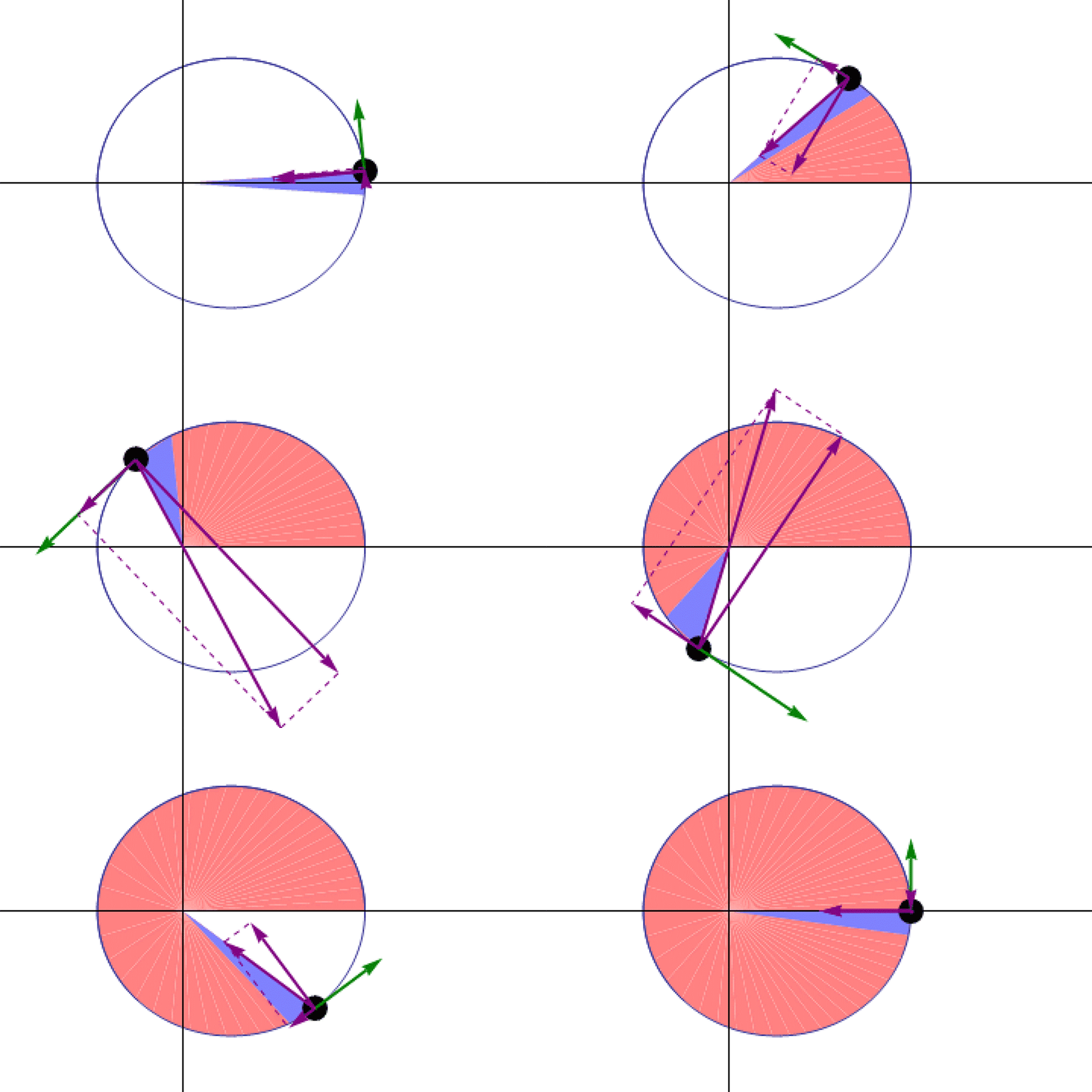
Before we understood how the law of gravity worked, we were able to establish that any object in orbit around another obeyed Kepler’s second law: it traced out equal areas in equal amounts of time, indicating that it must move more slowly when it’s farther away and more quickly when it’s closer. For extremely elliptical orbits, such as comets, the velocity near perihelion is enormous, while the velocity near aphelion is relatively tiny.
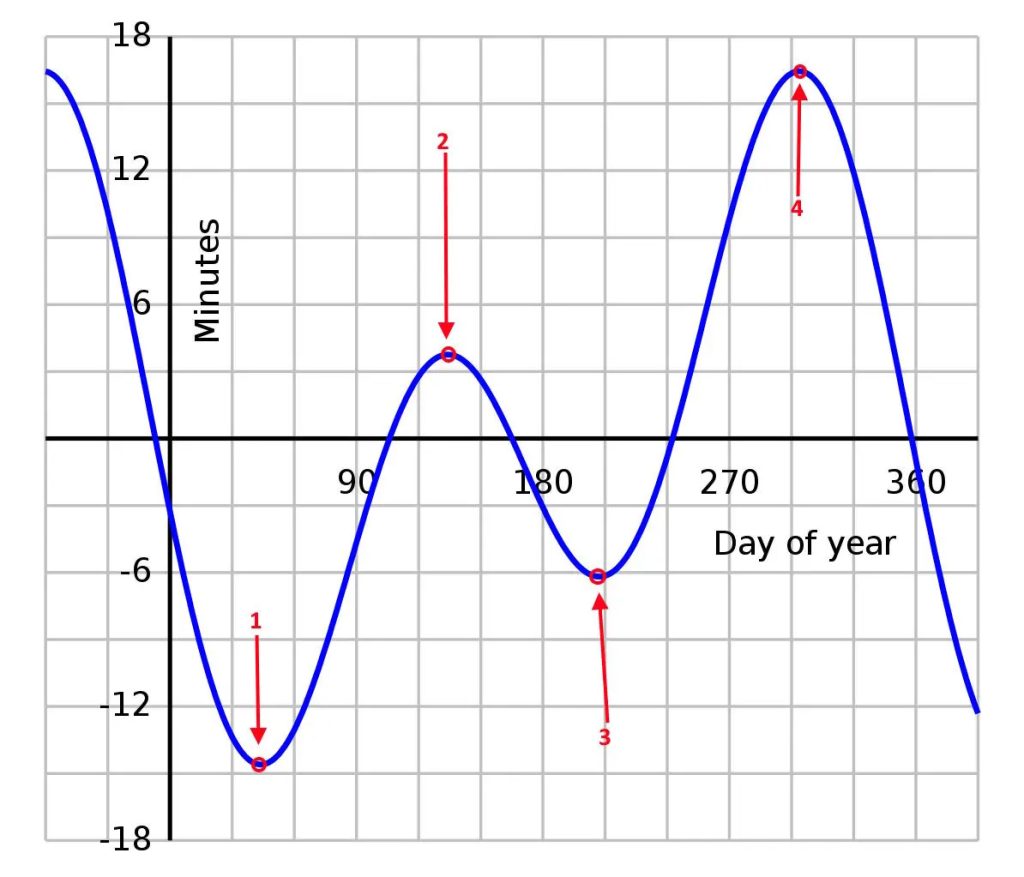
This means that the length of one-day changes and doing so in the most interesting way!
This graph shows the equation of time for a specific location on Earth. Where the slope of the graph is positive, days are shortening; where the slope is negative, days are lengthening; where the slope is zero (at the four locations marked), the day is precisely 24 hours. This happens four times per year in a latitude-dependent fashion.
This is another very cool example of complex sinusoidal motion and waveforms. Fascinating!
What Exactly is a Year Anyway?
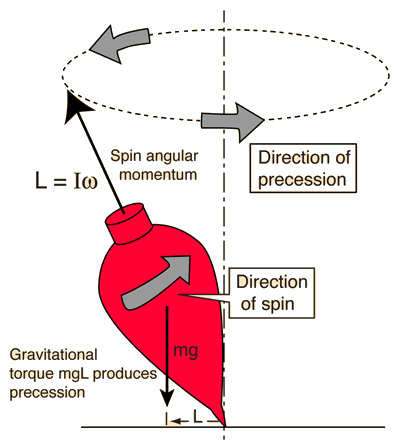
The next cool fact is a little hard to grasp at first. I’ve always known that the Earth’s rotation axis is tilted (23.5 degrees), but it turns out the axis precesses over time (20,000 years).
Think of a spinning top where you see the very top wobble to trace a circular path.
The Earth, moving in its orbit around the Sun and spinning on its axis, always defines “noon” and “midnight” in the same fashion: where the Sun’s height above or below the horizon is maximized. This moment in time doesn’t correspond to when Earth has rotated 360 degrees from the prior day, but rather closer to 360.9856 degrees, owing to the added effects of Earth’s motion around the Sun.
The net effect is that every time the Earth completes a full rotation around the Sun, it is positioned slightly differently than the previous rotation. The time it takes for four complete seasons (for example, the time between summer solstices) is 20 minutes shorter than for one full rotation around the Sun.
Long, Slow Burn
Finally, it makes sense to me that everything is slowing down. It’s sort of like increasing entropy. I was surprised to learn that over the course of Earth’s history, it has slowed from 6 to 8 hours a day to 23 hours, 56 minutes, and 4.09 seconds.
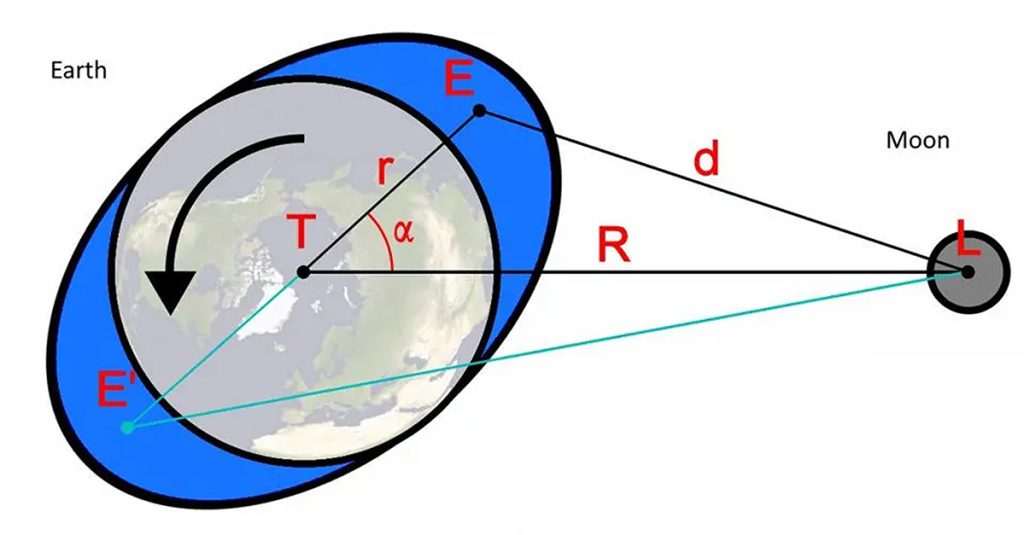
The Moon exerts a tidal force on the Earth, which not only causes our tides but also causes braking of the Earth’s rotation and a subsequent lengthening of the day. The asymmetrical nature of Earth, compounded by the effects of the Moon’s and Sun’s gravitational pulls, causes the Earth to spin more slowly. To compensate and conserve angular momentum, the Moon must spiral outward. For this reason, Earth will no longer have total solar eclipses after another 600 million years, and the length of each day will get longer as time progresses.
If we keep using our current calendar, we will eventually not need a leap day and will even have to eventually remove a day from the calendar rather than add one.
Just How Fast Are We Going, Anyway?
One other cool fact. While traveling at 67,000 mph around the Sun, the Sun is rotating with a fantastic velocity of 448,000 mph around the galactic center (a big black hole called Sagittarius*). The Milky Way itself is moving 1,300,000 mph through the Universe.