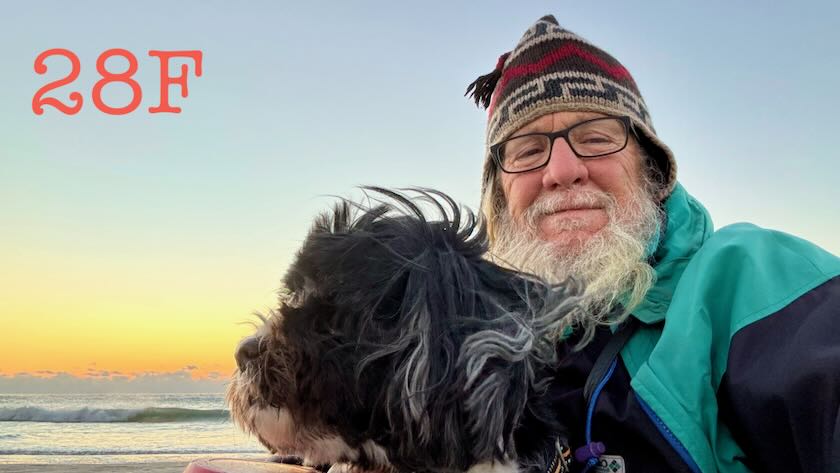
In 1989, I spent Christmas with my family. One of these suckers blew through then with devastating effects on the foliage. I specifically remember the Thousand Islands in the following years. Most everything was either killed or suffered serious damage. But the nice thing about Florida is that stuff grows back quickly!
Cold February Sunrise 2026
35 years later and now I live here. This one had plenty of warning, unlike a hurricane, but not really a lot I could do. It dropped down into the upper 20s in the early mroning which persisted until about noon. The next moring it dropped to just above freezing.
I have some nice, mature plants in the yard. Seems like most everything took a hit, including the two philodendron plants passed down from my Mom 50 years ago now planted in my backyard.
Time will tell and I will update this page periodically with the long term results.
Bald, rich guy Jeffery ‘Dick Pic’ Bezos confirmed his status in the Ultra-Rich Guy Rocket Club this past week, launching the New Glenn rocket for the second time. I was impressed by the really loud roar the rocket produced on the crystal-clear lunch day. More like what I remember with the Saturn V and its huge engines.
The Big Dildo and Crew
Very impressive compared to his smaller Big Dildo Rocket, he uses to launch his harem and other interesting people like a 90-year-old Captain Kirk into space. This new one is serious fucking business.
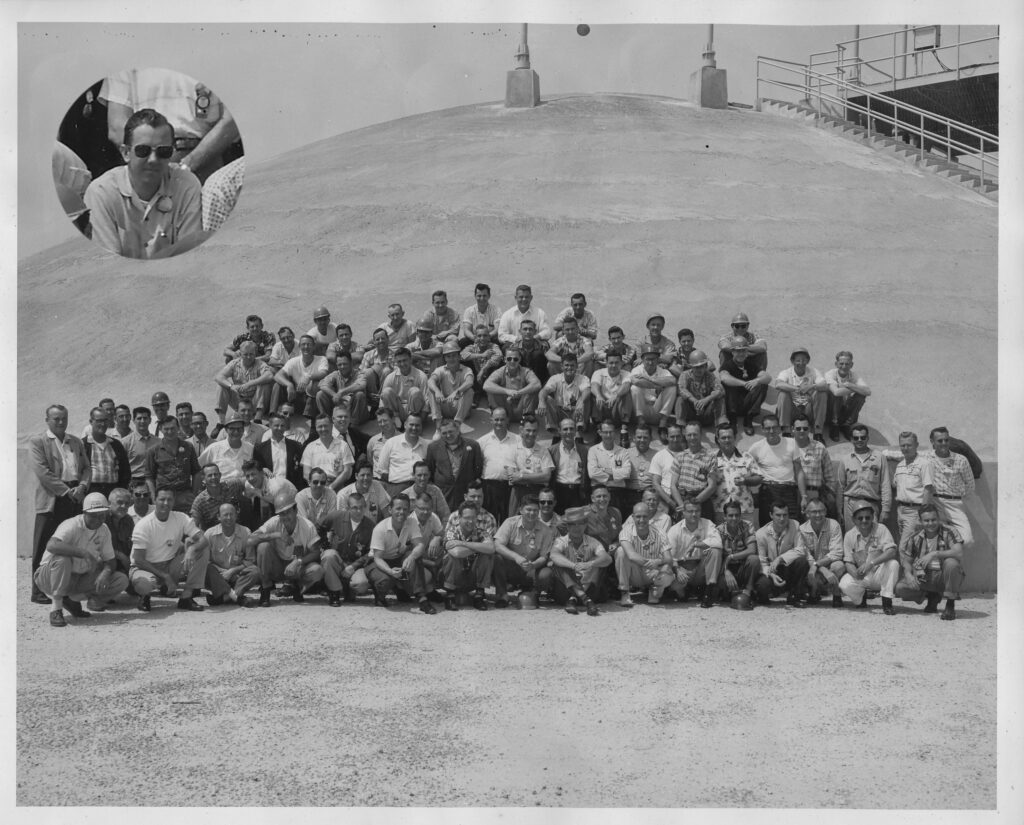
Getting in the Way Back Machine, we go back to the early 1960s when Dad, working for General Dynamics, is involved in launching the first major rocket, the Atlas, into space. I would eagerly watch every launch.
Dad with the Convair Atlas Team in the late 1950s
At Cocoa Beach Elementary School (more commonly known as Freedom 7 after a name change), my class would regularly walk the half-dozen blocks from the school on Fourth Street South (less than a block from where I live now) to the beach. Right out at the end of Cape Canaveral stood Launch Complex 46.
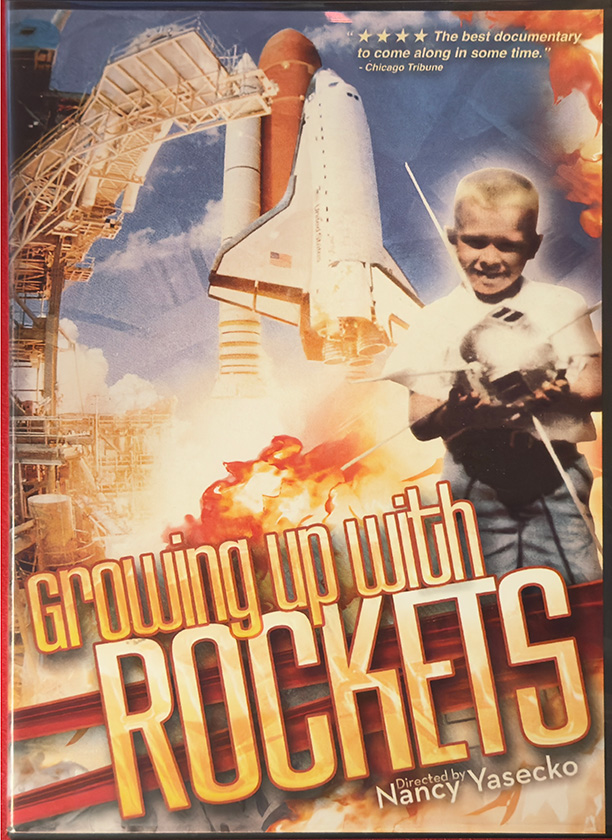
A documentary about growing up in Cocoa Beach by local Nancy Yasecko. She briefly dated my friend Bill in high school. Her father was an eccentric missile man and drove a very odd car with a fiberglass bubble on it (I think it was a Corvair). Anyway, she talks about how we would walk in single file to the nearby beach to watch the launches. I now live a short walk from that beach.
We would watch the rockets launch, knowing that many of our fathers (and perhaps mothers) were responsible for what we saw. Sometimes they would blow up! That was cool. But it was very satisfying to see them disappear into the blue sky, which was more often the case.
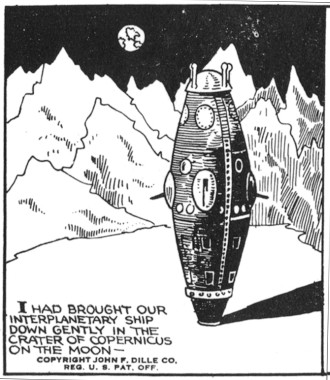
As a young boy growing up in this setting, I was enthralled with everything space. I especially enjoyed reading about the adventures of Buck Rodgers in the 25th century!
I was very curious why Buck could land his spaceship and we had not. I guess we had not figured that part out yet.
That turned out to be true. But who would have thought that it would be done by a billionaire rather than my dad and his buddies!
The New Glenn booster is sitting on Jeff Bezos’ mother, Jackie. She sure must be proud of her son. Prounder perhaps than his ex-wife, MacKenzie. After the dick pics, she gave a big chunk of her divorce settlement to foolish things such as helping people instead of huge, powerfuyl phalic symbols. Ha!
When I first moved back to the area, SpaceX finally succeeded in landing their booster after six tries. Ten years later Blue Origin does it with their second launch. Still not sure what took them so long but I look forward to seeing more of them.
Billionaire Row at Port Canaveral. Blue Orign on the left, SpaceX on the right.
During our 2024 Excellent Adventure, we stopped to visit Myhra’s brother Richard and his wife LaRae in North Dakota. They are both woodworkers, and Richard gifted me a large live-edge slab of maple, about 15 inches wide and six feet long. The bark edge was in great shape, and it had been well seasoned after 20+ years in their shop.
I decided to cut the salt into three pieces, flatten them, and then use my optical router to fashion some items for myself and both brothers. This required that I build a router sled for flattening the rough slabs. Manufactured flattening sleds can be quite costly, but I found a kit from my favorite woodworking supplier, Lee Valley.
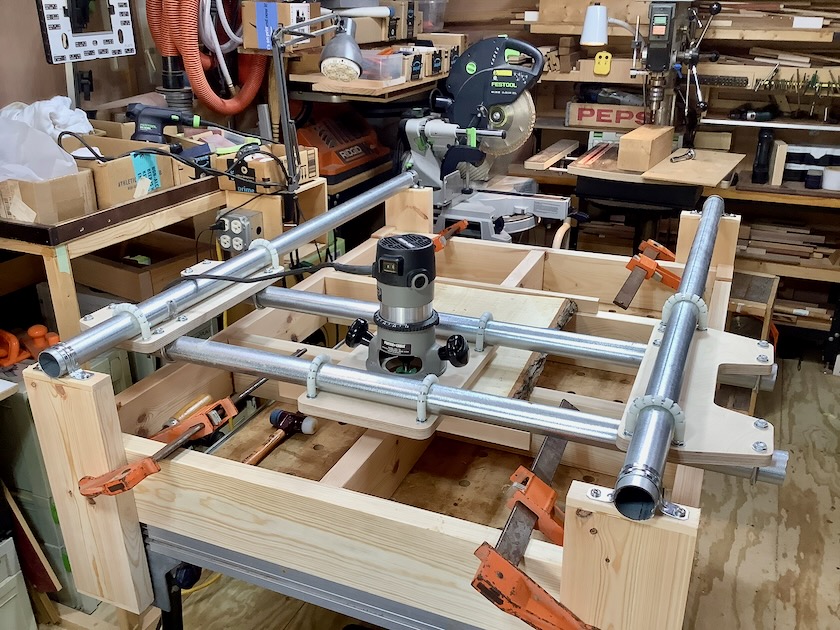
The sled straddles a base made from 2 x 6 lumber. The rails are made from 1 1/2″ EMT conduit. The sled moves easily across the slab fixed to the base. The router holding a 1 1/2″ surfacing bit is mounted to the sled.
I designed the sled to fit the size of the work, with the intention of using it on my trusty Festool assembly table. The design made it easy to disassemble for storage. The sled uses common 1 1/2-inch steel pipe, commonly used for electrical conduits. A clever arrangement of plastic spacers stacked on a U-bolt allows for the x-y translation of the router. The router itself was my larger Porter Cable with a 1 1/2-inch facing bit.
I took small cuts to insure a smooth operation. Sawdust flew everywhere!
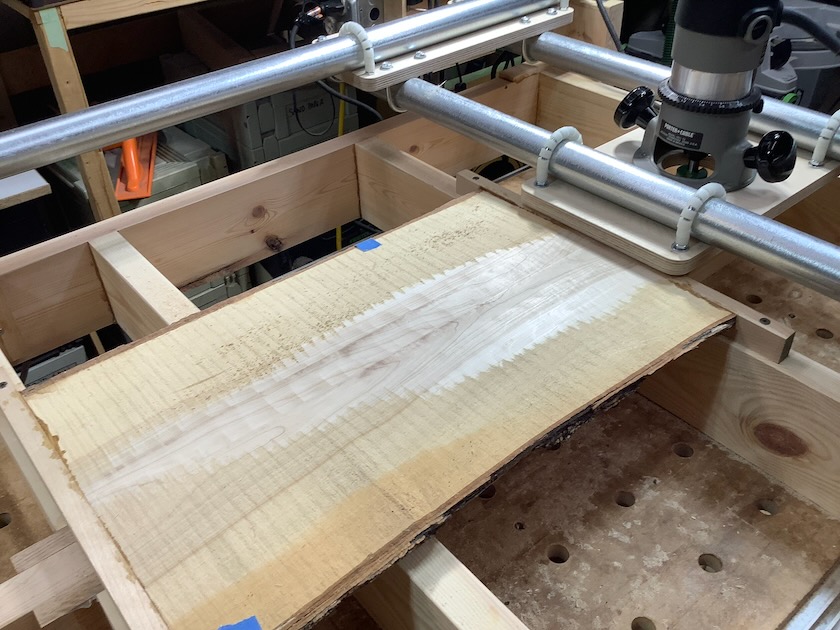
I glued some strips on either end and fastened the slab to the base of the sled. I lowered the bit about 1/16″ per cut. I had to use a full-face mask and respirator as the sawdust flew everywhere! I cut the slab down with long cuts. For the final cut, I moved it side to side as I traversed the length of the board. The bit was ever so slightly tilted, but the result was better than I expected. I finished it with 80-grit sandpaper.
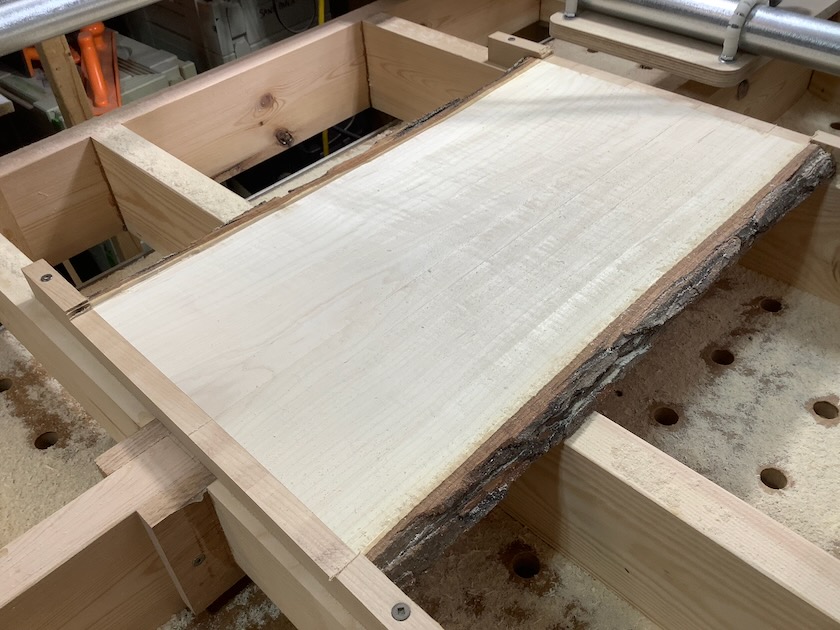
A finished surface. I was happy the bark was also cleanly surfaced. Some sanding with 80 grit sandpaper removed any unevenness left by the cutter head.
L+D Ranch
I made the letters out of mahogany. They were designed to protrude slightly from the surface. I then used a very small router to round the tops of the letters. I think it is a very nice 3D effect!
Detail showing raised lettering
Tree of Life
This was my most detailed inlay work so far. I cut the pieces out of paper-backed veneer with no substrate. I had good luck with that on my last work. 45 individual pieces were cut along with the large, detailed tree.
I found this design on line as an image file. I used a very nice file converter that created a SVG format file required for the CNC programming.
This involved using progressively smaller bits, 3/32″ and 1/16″ for the sharp corners and overlap in the cuts. I numbered each piece as I cut out the leaves. Finally, a lot of detail trimming and sanding to achieve a (often) perfect fit! Every time I do something like this, I am stunned by the accuracy of the Shaper router. This was always something I wanted to be able to do, and I did it a few times by hand, which was very time-consuming and not as accurate.
This is one of two I crafted along with the one at the top of the page. I wanted to give my sister-in-law Myhra and brother Rick somthing from the live edge slab Myhra’s brother Richard gave me on Excellent Adventure 2024.
I finished all of the pieces with Rubio Monocoat epoxy finish. It sealed the bark edges very effectively, so I feel confident they will remain in place.
I remember, about 10 years ago, mentioning to someone that it felt a bit odd to turn 60. He said something to me about himself turning 70 that has stuck with me for the past 10 years. Not actually what he said but the way he said it. I see his point now.
😳
It’s been fun being retired. I simply can’t understand why anyone who can afford it would want to work again. It’s not like I actually needed all that activity to fill my day. I’ve really enjoyed the time to explore the things I always loved. It’s been a bit tough to have to give some of the stuff up and on the other hand a joy to be able to do so much more with the other interests I have.
Life, The Universe and Everything
When I first retired I was very interested in gaining a better understanding of the world around (or perhaps more appropriately within) us. I could draw on my 18 or so years of big brain stuffing to try and understand it. There was much less to distract me.
You are full of protons that actually look nothing like this. The point is that protons are made up of quarks and virtual particles popping into and out of existence . The whole bubbly mess is held together by gluons (no shit, that’s what they are called). Gluons have no rest mass like a photon. Any particle that does not have rest mass has to move at the speed of light. Motion, indeed!
I started with attempt to understand time, only to find out how little we really know about it. More recently I have become interested in consciousness, something we seem to know even less about. At its core I now understand time and consciousness both to be simply about change and change is simply due to the fact that everything that exists is constantly in motion.
So here I am at 70! QED!
And one peculiar point I see As one with many ones of me As truth is gathered, I rearrange Inside out, outside in Inside out, outside in Perpetual change
Yes, Perpetual Change, 1971
I feel lucky to be born in an age that we’ve finally been able to overcome some of the trappings of earlier humanity in order to see existence for what it really is.
Red or Blue?
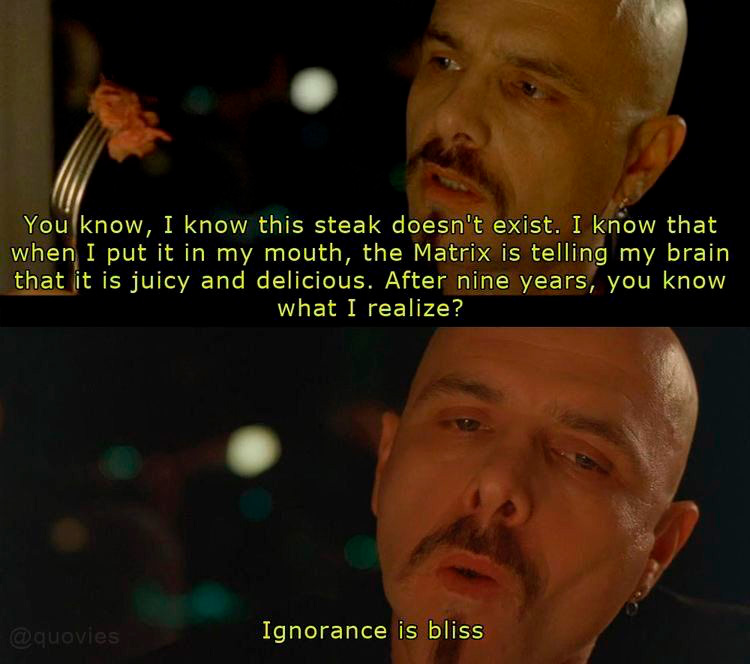
Morpheus and his pills
My brother and I recently talked about why the followers of Abraham have had humankind by the short hairs for so long now. He argues that it’s sort of like the blue pill in the movie the Matrix. Sometimes I feel a bit like Cypher in the movie The Matrix.
I certainly learned a lot of pithy sayings over time in the cult of Bill and Dave. I’ve tried to use some of them to correct my behavior with limited success. One of my favorites:
Things are exactly the way they are supposed to be, otherwise they would be different.
Pithy AA saying
This certainly does not imply determinism on my part but it does imply acceptance. Alternatively, the only thing I can truly control is the way I perceive and react to any given situation.
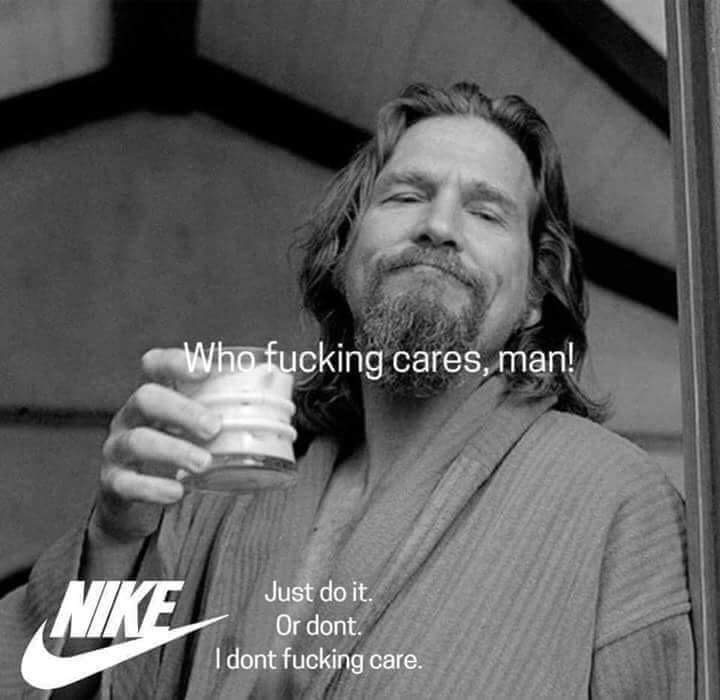
Yes – acceptance is the answer for this Dude it seems.
Acceptance – The Dude Abides 😎
Free Will & 73
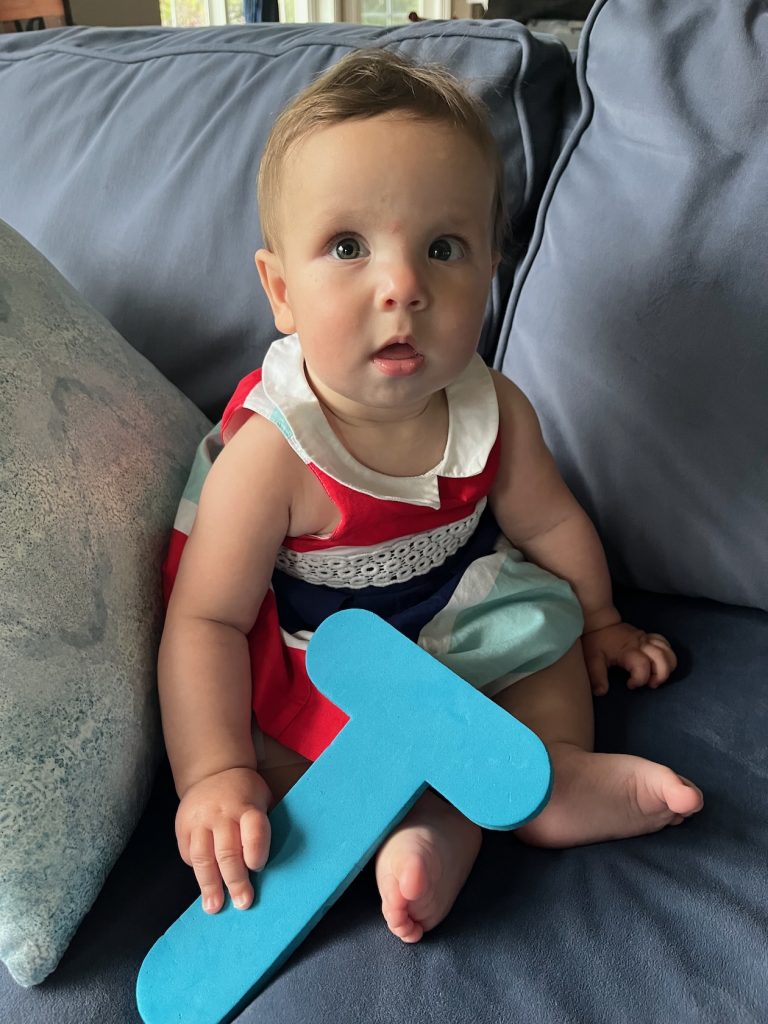
Clan Tubridy, among others, was recently touched by the birth of a baby girl Georgiana Marisa. First female Tubridy in my branch of the Clan since 1891! I have determined that bodes well for me!
Georgie T – The most photogenic Tubridy ever!
I am now facing a legacy of 73: As long as any male Tubridy that I am directly descended from has lived. Wow!
I will choose (because of my free will and nothing else) to look at it like this:
The fact that we have the first Tubridy girl since 1891 surely means I can make it to 74!
Time, what ever it is, will tell. In the meantime, I will continue to relax and enjoy the ride!
Last stop for the trip at my brother and sister-in-law’s retreat in the beautiful mountains in western North Carolina. This will be our second visit. The Dead Horton’s Tour was timed around the Highlands Motoring Festival taking place in nearby Highlands.
Jake enjoying the sensational view!
This Excellent Adventure has had some great visits to museum. I have been coming to this area since the late 90s and one museum I never made it to was the famous Firefox Appalachian Village and home to the phenomenal series of books detailing early Appalachian life in the area.
Highland Motoring Festival
Highlands Motoring Festival Street Parade 2025
We first experienced the parade that occurs the night before the show. I was excellent and some of my favorite cars were on display. Good thing too since they were not on the festival grounds the next day.
The next day featured the cars on display. There was a special pre-WW2 section which had some unbelievable cars! A real treat to see some of this older engineering and style marvels in such good condition.
1925 Rolls-Royce Silver Ghost Piccadilly Roadster, once owned by Howard Hughes. This car is one of only 79 left-hand-drive Piccadilly Roadsters built in Springfield, Massachusetts, specifically for the US market. Hughes ordered the car in December 1924, paying $13,450. The vehicle is known for its unique features, including a golf club compartment.
The rest of the show featured several modern marquees: Ferrari, Aston Martin, and Porsche. BMWs were far and few. There were some interesting cars including a Shelby Cobra.
Shelby Ford Cobra at Highlands Motoring Festival
By far the most interesting marquee was Ferrari. The post war cars up to the $750K Green SF90 Spyder were on display. One guy told me they feature one marquee every year and this year it was Ferrari. I even saw a Ferrari F40 similar to the one I drove in Las Vegas all those years ago.
The Foxfire Museum
What is Firefox?
In high school, my girlfriend introduced me to the Firefox books. Her father was a mountain man from the Pacific Northwest, and her mother was a librarian. I didn’t really pay much attention to it, but it fit into the mood of the early 1970s.
The story is much more interesting now. Turns out it was about enabling the young people of this region to fit into a rapidly changing world of the 1960s. Educators and the students attending a local school came up with a project to interview their elderly forebears. In the process, they learned the skills necessary to survive in the wilds of Appalachia. It was right up my alley now.
The Firefox Museum: Nestled in the hills of Georgia, brings insight into the early Appalachian region through their successful life skills education programs for young people.
The museum showcases both work by the students as well as preserved homes, barns, and other structures. Signs gave you a basic understanding of what was being shown. I especially liked the woodworking and tools. I also appreciate the fact that the museum is still working with the local youth.
The Foxfire Museum: Every year, students come and experience the life skills of their forebears. It’s a proven success to help the children of this area lead more successful lives.
The feel was very similar to the experiences I had at the Wright Brothers Monument, Mystic Seaport, the museum in Lancaster County, and Monticello. A fitting end to two great learning experiences.
Ringing the church bell at the top of the hill
Back at the Ranch
We spent a few days hanging out with the family. Very relaxing at the ranch – a great end to a excellent adventure.
Hiking with the pups on Chestnut Mountain
Two days to get home with a stop back at our favorite spot south of Savannah.
Excellent Adventure 2025 wraps up with a final stop in Savannah Georgia
In Big Stone Gap I met up with brothers Rick and Dave to explore our grandmother’s ancestors – The Hortons. They are buried at different cemeteries in the area.
G-3 Thomas Horton
Thomas Horton ( 1801-1884) was the first Horton born in southwest Virginia near Big Stone Gap. His father, John M. Horton III, moved there sometime after the Revolutionary War. He was a minister, married twice, and fathered 15 children. His cemetery was remote but kept up.
First stop was G-3 Thomas Horton in the Miles-Craft cemetary. The cemetery was on a hillside near the Clinch River northwest of Gate City. It took us a while to figure out how to get to it but when we did we found a reasonably well kept cemetery with a new looking chain link fence.
He was the first Horton born in the area after his father, John Horton, moved to the area following the Revolutionary War. He is buried next to his second wife Martha Catherine Stewart. There was a fantanstic vieew of the countryside from the cemetery.
Harlan County Kentucky
Unincorporated Coxton, Kentucky. Dad was born here in 1929 when the area was booming from steel companies operating mines in this part of Kentucky.
Next stop was Coxton Kentucky. This is where Dad was born in 1929 while his father was working on the nearby coal mine. It’s nearby the town of Harlan which has gained notoriety over the years.
Mining in this area got a big push towards the end of the 1800s. Promoters claimed it was the next Pittsburg as the easy to mine coal was extracted and sent to the steel mills in the north. The mine workers sought to organize so the mine operators brought in immigrants (like my mother’s parents) to work the black seam. It didn’t go well and at one point several men were killed as the tension escalated.
Dead Hortons Tour ’25
In more recent times the demand for coal dropped significantly in the later part of the 1900s. People left the areas, quite often in ruins as we saw later driving home through Lynch Kentucky. Coxton was hit hard. They finally lost their post office and the unincorporated area’s most recent census showed about 250 people living there.
We drove around the area while the locals sat on their porch and glared at us. At least they didn’t shoot. Crime in rampant in the area after the opioid epidemic that swept through the area this century. It was pretty bleak looking. I found a blog on Tall Tales From Capt Rogue site that has the best information I could find on the area.
We headed back to Big Stone Gap along Highway 160. This went through the heart of coal’s heyday as exhibited in the town of Lynch. At one point in the early 1900s this town has a population over 10,000 working the mines. Large buildings for the mining operation and town were built. After the Second World War the demand for steel started to drop and the operations slowly wound down. The mine owners (steel companies) started demolishing builds and in 1963 the town was incorporated as production ceased. The infrastructure was turned over to the residents to own and manage. A good article on the town can be found on the website Abandoned Places.
On the Trail of the Lonesome Pine
We left Lynch as wound down the Trail of the Lonesome Pine into Big Stone Gap. This was a roller coasted ride of switchbacks (gracefully managed by driver Brother Dave!) that wound down into Big Stone Gap. We caught some beautiful scenery including a huge area that had been strip mined. Lots of that in this area.
Pizza in Big Stone Gap
We had some big fun that afternoon swapping our tall tales over some brews and bongs (herb is legal in Virginia, but you can’t buy it or sell it – huh?). The next morning, we loaded up for the final leg of the tour in the Gate City area.
Gate City
My grandmother was raised here and retired with my grandfather here in the late 1950s. We reminisced about how little we knew about her relatives when we were growing up. After her parents died, Sarah was raised by Grand Uncle Nelson Horton. He was only 10 years older than her father, Lucien. Nelson was from a second marriage of Rev. Thomas Horton, who had a total of 14 children from 1821 to 1871. We always thought she might have been an only child!
G-2 William Patton Horton
Ewing Cemetery near Moccasin Junction, about 7 miles east of Gate City.
Our first stop was near the intersection called Moccasin Junction. G-2 William Patton Horton is buried here with his wife, my G-2 Eleanor Marie Ewing. The name of the cemetery bears the Ewing name. Dave dug up a great, current website of Clan Ewing of Scotland with a reference to their marriage. Located less than 10 miles east of Gate City, the cemetery was located on a hill and was reasonably kept up. Another beautiful view of the countryside.
G-2 1st Lt. William Patton Horton ~ Co. A 22 VA Cav C.S.A
G-2 Ellen M Ewing wife of W.P. Horton ~ 1831-1891
William had the distinction of serving as a first lieutenant in the Civil War. Fortunately for us all, he survived! He was also listed as a farmer and merchant. He fathered six children, including my great-grandfather Lucien Beauregard Horton.
G-1 Lucien Beauregard Horton
Dr. L.B. Horton 1861-1913 and Mollie 1873-1912, his wife in Estil Cemetery in Gate City
Next was G-1 Lucien Beauregard Horton’s grave and that of G-1 Mary E. Ison. We saw her family name on numerous other markers in the cemetery. It was located in the town of Gate City itself and was by far the largest of the three.
Estil Cemetary ~ Gate City
Lucien, a doctor, we believe was educated by a Civil War veteran whose father Lucien had served alongside. His obituary, extensive and reflecting his Christian faith and compassionate nature towards those in need, highlights his early demise. Interestingly, my grandmother was taken in by one of his uncles and, at one point, listed as a daughter, leading me to believe she might have been adopted.
Estil Cemetary ~ Gate City
Our Grandparents
We left the cemetery and headed for our grandparents’ house. Located west of town, we visited here many times while growing up. Behind their house was a small Catholic Church that my grandfather attended. He donated an organ to the church sometime after his retirement.
Grandparents home in Gate City: We were fortunate to meet up with the current owner Joann. We visited annually while growing up. Not a lot to do but a lot of memories!
To our surprise, we got to meet both the current owner of the house and Father Tim at the church! We had a great time learning about what happened after they passed.
Saint Bernard Catholic Church nearby my grandparents house on the east side of Gate City
St Bernards Catholic Church: My grandfather donated this organ to the church. He was a member of the congregation. His wife, however, was not.
They also mentioned an old restaurant, Hob Nob, that we frequented while visiting. We had such a good time there, and the memories resurfaced. It was always a highlight of our visit!
Hob Nob in Gate City. We would come here as a treat when visiting our grandparents.
60 years later! At the Hob Nob in Gate City.
Our final stop was Holston View Cemetery, where my grandparents, Edward Bernard Tubridy and Sarah Ellen Horton, are buried. Jake and I visited their grave site in 2017, which was a good thing because I remembered their location on the vast cemetery grounds. Unfortunately, there was a fire, and some of their records were destroyed.
Our grandparents grave sites at Holston View Cemetery in Weber City VA
They have a great view as did most of the cemeteries we visited.
Holston View Cemetery in Weber City VA
We parted ways there, and my brothers headed back to the ranch in North Carolina. Jake and I headed back to Big Stone Gap for our last night before joining them.
My focus changes now. Picking up where I left off last year, I rescheduled my trip to research my Horton ancestors in the southwesternmost part of Virginia. I met up with brothers Rick and Dave to tour the Hortons’ cemeteries. Our home base was Big Stoner Gap. I mean Big Stone Gap! Sorry 🤣
The two-day journey to Big Stone Gap took across the mountains just south of Shenandoah National Park. From there, it was a scenic drive southwest to Wytheville.
The campground here was spacious and offered a plethora of activities for children and families. I thoroughly enjoyed taking a dip in the pool.
It was a short drive from there to Big Stone Gap. It was like riding a roller coaster, crossing the hilly terrain. At one point, we passed a huge Hitachi power generation facility next to a coal mine. A billboard proclaimed that the locals did not want any data centers to power our robot overlords (this is a big deal in northeastern Virginia). That was the first of several surprises on this part of the trip. But I digress.
Big Stone Gap
Big Stone Gap has played host to the longest running outdoor theater in the United States: Trail of the Lonesome Pine. I saw it as a child on one of our visits to nearby Gate City where my father’s parents retired. It tells the tail of two feuding families in the area. Of course, one member from both families fall in love. An Appilacian Romeo and Juliet.
Big Stone Gap shares a similar legacy with Mystic, as both have been the setting for a rom-com movie. There are several museums here too. A a Flower Shop with the name Horton on it! More on that in a bit.
Big Stone Gap
We pulled into a beautiful campground on the banks of the Powell River in Big Stone Gap. We parked next to the river and a beautiful grass pasture.
Big Stone Gap
We met Jesse, the daughter of the guy that built this place and current owner. She was born and raised here and takes obvious pride in her beautiful campground. The office features wood carvings her father had done.
Southwest Virginia Museum Historical State Park
Southwest Virginia Museum Historical State Park in Big Stone Gap.
Rufus Ayers’ grave in Gate City with G-1 Lucien Horton
I checked out the museum before my brothers arrived. I was hoping to find some references to the Hortons and learn more about the area. The museum was originally the home of Rufus Ayers, who served as the Attorney General of Virginia in the late 1800s. We came across his grave in one of the cemeteries in Gate City we visited the next day.
The home is in beautiful shape and the woodwork inside is beautiful. I particularly enjoyed the exhibits on coal mining. I learned, among other things, how important the role of the surveyor was. This was a skill my Grandfather Edward Bernard Tubridy had when he lived in this area in the late 1920s when my father was born.
Southwest Virginia Museum Historical State Park: Beautiful woodwork throughout the home.
John Horton was named on one of the displays in the museum.
I did come across a reference to John Horton. My G-4 grandfather was John M. Horton III. Could these be the same? There are references to the Gilley family, which does not show up anywhere in our genealogy so far. Another display showed the routes the settlers took.
This exhibit showed the trails used to take pioneers into this area. Our family likely traveled the Great Valley Road from Russell County Virginia near Washington DC in the late 1700s.
I also appreciated how the museum portrayed life during the coal boom era. It served as an excellent prelude to the upcoming Dead Horton Tour!
One of America’s most beloved founding fathers believed in religious freedom – including none at all. The Dude abides.
It was a scenic drive to Charlottesville (known to the locals as C’ville), Virginia, down the Shenandoah Valley. Truck traffic was heavy but much better than the last segment of the journey. It was raining in the early morning but cleared up before we left and was very nice all the way to C’ville.
Shenandoah Valley
The campground was hidden away about 10 miles south of town. Our spot wasn’t great but nice enough considering it was the last one available (at least for my size) when I made the reservation a couple of days ago. The pool was nice and there was plenty of place to let Jake roll. He likes the smells here.
Charlottesville KOA
One family I talked to was in town to see a C&W performer. When I got set up, I checked my hunch: this was the hometown for Dave Matthews Band. They are one of my all-time favorite bands, with the stellar drummer Carter Beauford (and Dave’s not too shabby!). I expect this place to have a good vibe.
Monticello
Thomas Jefferson’s last portrait. The Dude aged well!
The estate of Thomas Jefferson has been on my list for a very long time. Mostly because I know several people who visited and had very positive comments. His legacy certainly speaks to his interesting character as a founding father.
I started by joining a tour and listening to Debbie, a local 4th-grade school teacher, talk about Jefferson, the plantation he inherited from his father, and the enslaved people in his care. He named the plantation Monticello after spending time in France as an American ambassador. In Italian, it means little mountain.
The main building was a labor of love taking over 40 years to complete. This is the famous West view that is shown on the not-so-common two dollar bill (pre 1963) along with Jefferson’s mug on the obverse.
Jefferson was an American Renaissance man like some of his contemporaries, including Ben Franklin. He was a self-taught architect and designed all of the buildings on the grounds. After living in France, he reworked the main building to incorporate sensibilities he picked up there.
A polygraph used by Jefferson. Whenever he wrote a letter this machine would make a copy. He was fanatical about record keeping – almost a compulsion it seems.
He ventured into many different money-making schemes along the way. He manufactured nails early on. He switched crops from tobacco to wheat at one point. Most of the work, of course, was done by the enslaved people (his preferred term) – upwards of 400 of them over time. Most of them were inherited from his father and father-in-law. The museum delves into enslavement very thoroughly.
Mulberry Row at Monticello. This is where the enslaved people lived and worked. Most buildings are long gone and some have been re-created. Like most owners of enslaved people, he treated them well enough so they could work their lives away.
In addition to fathering 6 children with his wife, Mary (his third cousin and a widow at 23), he also fathered 6 with his enslaved concubine, Sally Hemmings, after Mary passed away. She asked him to never marry again, apparently because of the relationships she had with her two stepmothers. His relationship with Sally was very complicated and still has doubters. What is known is that at age 16 she was given the chance to remain in France as a free woman. She chose to return with Jefferson under the conditions that her children with him would be freed.
Monticello, Charlottesville, VA
And of course, while all this was going on, he spearheaded the writing of the Declaration of Independence, was the 3rd president (two-term), ambassador to France, and designed the University of Virginia (which can be seen from the grounds). He lived to 83 to boot. Quite a man and a beautiful plantation.
After the visit, Jake and I checked out C’Ville. It was jammed with people and traffic but looked very hip. It’s a university town, and it shows. I stopped at my favorite Whole Foods for the first time on the trip. It was jammed on a rainy Sunday afternoon.
Dip in the pool before the next thunderstorm begins!
Back for a dip in the pool. Tomorrow, we hoist anchor and head for a family reunion at Big Stone Gap. They made a movie about this place too, but with Whoopie Goldberg.
St. Peter’s Roman Catholic Church in Harper’s Ferry
Our drive from Pennsylvania took us through Maryland, Virginia (briefly) and finally West Virginia. Our family has a lot of history in this state!
On my last stop in Lancaster County I learned about the importance of transportation in this area. Pennsylvania is the fifth largest state and ninth in population density. What that means, essentially, is that there are trucks fucking everywhere. Especially, it seems, on the otherwise scenic roads I traveled on to get here. One almost took us out – when I looked in the rear view camera he was awfully close! At least I know now I can make a panic stop in Starship Excellent Adventure (read activated ABS). Big fun!
Gettysburg Flyby
Gettysburg with Abe: When I inquired if he perceived things as unusually peculiar compared to his carefree days, he responded with a simple yet profound statement: “The Dude Abides.” It was a moment of profound insight and wisdom.
We decided to see what we could see at Gettysburg in Starship Excellent Adventure with both Saucer and Engine sections attached. Turns out not much. But we did get really hot walking around the Visitor’s Center (no dogs allowed inside) and a chat with Abe.
We arrived at our big campsite denuded of any trees where we landed the Starship. This one is a Holiday KOA meaning kids everywhere. I can’t believe they charged me a pet fee and want me to wear a fucking wristband.
Not a tree in sight at our Harper’s Ferry campground! Well – at least nearby 😟
The rest of the park was quite nice and I did enjoy a dip in the pool.
Harper’s Ferry
Confluence (I really like that word) of the Shenandoah and Potomac rivers at Harper’s Ferry. The Appalachian Trail goes over the bridge shown in the beginning.
Harper’s Ferry was established in the mid-1700s by a dude named Harper. It sits at the confluence of the Potomac and Shenandoah rivers and was an excellent place for a ferry and water wheels to power machinery. Washington DC is about 50 miles downstream of here.
Harper’s Ferry National Historical Park: Site of the old armory. It was lower down to the water than the surrounding area.
George Washington visited here in 1785 and liked what he found. Not much later, it became strategically important for the manufacturing and storage of guns at an armory that was built near the river. Most of the history from that point centered around the armory.
Harper’s Ferry National Historical Park
Work was done here to prepare for the Lewis & Clark expedition. Weapons were procured from the armory. He had a collapsable steel framed boat made here that was critical to their success. Early work in the standardization of gun parts using precision molds followed as a result of this effort. An industrial revolution all our own.
Pulp Factory: The ruins of a pulp factory were upstream on a canal diverted from the Shenandoah River. The water power available from the confluence of the two rivers made for a good area for these activities.
Later, just prior to the Civil War, it was the scene of John Brown’s raid. Brown was an abolitionist and planned to raid the armory and arm the slaves in rebellion. It didn’t work, and they hung him. Prior to his death, he predicated that the Civil War would begin soon.
Harper’s Ferry National Historical Park
A couple of years later, he was proved right. During the Civil War the armory was a target. It was burned and all the weapons seized. Yet it remained a vital part of both the north and south’s ambitions, changing hands 8 times during the war.
Harper’s Ferry National Historical Park
The impact of John Brown’s legacy lived on as the first college for anyone was started here after the war. White, black, male and female – everyone was welcome. How fucking cool is that man!
The area changed status from a Monument to a National Historical Park. The restaurants downtown probably make a fortune in the Summertime so many people visit here. They bus them in on shuttle buses.
Laundry day at Harper’s Ferry KOA. A storm came through and gave me a second rinse! I cleaned the car too! Thank you, Mother Nature!
In the afternoon we were treated to a downpour. Heaviest rain since the Outer Banks. Next stop is Charlottesville, Virginia and a visit to Monticello.
Amish farm in Lancaster County, Pennsylvania. They basically live in fear of God and work to suppress their Free Will. Not so sure if the Dude would abide, but hey, there’s always bowling!
After reaching the peak of our trip, we embarked on a southward journey. Our route took us back through southern Massachusetts and into the Hudson River Valley. Along the way, we made two stops before reaching our ultimate destination: Lancaster County in Pennsylvania. Lancaster County is renowned for its Pennsylvania Dutch heritage, particularly the Mennonites and Amish communities.
Sturbridge, Massachusetts
Sturbridge Massachusetts
The first night’s stop was in an upscale private resort near Sturbridge. There is a recreation of an 1830s village in Sturbridge that looked interesting. The area itself is heavily wooden part of southern Massachusetts near the border with Connecticut.
Canadian Goose Shit Beach: Honestly, these feathered rats that shit like dogs are a nuisance. I mean, live and let live— right? I vote we deport these nasty beasts!
The campground was first class with many indoor pavilions. It was set on a lake, and the beachfront was full of Canadian goose poop.
💩
There were dozens of bright, sparkling, prefabricated cabins— nothing rural here. I didn’t see a single one of them occupied. It gave the place a very eerie feel. However, there was a ring of high-dollar class A motorhomes occupying the front camping area. Starship Excellent Adventure fit right in!
The next part of the journey took us through well-known names like the Berkshires and the Catskills. As we made a sharp southerly turn, crossing the Hudson River, I vowed to actually see the river at our next stop! We passed Woodstock along the way. I asked a local about what was happening there, and she suggested a visit. A missed opportunity.
Plattekill & Poughkeepsie ~ New York
The campground was located in Plattekill near Poughkeepsie. I learned Poughkeepsie is called the “Queen City of the Hudson.” Not sure about that but boy was it a confusing place to drive through! I also learned the city gets its name from a word in the Wappinger tribe’s Munsee language, meaning ‘the reed-covered lodge by the little-water place’, referring to a spring or stream feeding into the Hudson Riversouth of the downtown area. Wikipedia
We set up camp in a nice campground, set up as a destination for the with-children set. Regardless, it was mostly people like me at this point. A local told me summer really doesn’t arrive here until mid-June, and the schools get out.
Plattekill New York
We set up camp and headed to Poughkeepsie. The roads are very curvy here and in pretty good shape. That, plus an aggressive driving style of fellow road warriors, made for a fun trip! We crossed the bridge and headed for the river.
Mid Hudson River Bridge to Pouchkeepsie New York
The bridge dumps you out into a complex traffic scheme full of u-turns and other funnery! We made it safely to the spot called Quiet Cove Riverside Park. We learned from a local hanging out there that it used to be a New York State (Mental) Hospital!
Hudson River at Poughkeepsie
In the series above, both the Pedestrian only bridge and Hudson River Bridge (two large towers) we crossed are shown separately. It was tempting to walk the Pedestrian bridge, but my back disagreed! I doubt Jake would have liked it much either.
We had another thrilling dash back to the campground after confirming that, indeed, the Hudson River met the specifications of a magnificent river!
Pennsylvania Dutch Country
The next day’s drive was a mix of beautiful scenery, heavy industrial traffic (e.g. trucks everywhere), and some seriously fucked-up roadways. After at least one missed turn, we finally made it to our campground about 10 miles east of Lancaster, Pennsylvania. The campground was on the side of a hill and has a stunning view of the farmland below.
New Holland campground in rural Pennsylvania
We arrived at the campground and noticed our first clue that we had left Kansas behind. Unlike most campgrounds I’ve stayed at, this one was clearly designed for older travelers. There were no kid-friendly activities at all. The campground boasted gorgeous green lawns and immaculate gravel. The next thing that became apparent was the subtle wealth. Several million dollars worth of high-end, Class A motorhomes, most of which were towing luxurious cars, lined the campground. Some of the nicest motorhomes I’ve ever seen were there.
New Holland campground with a view. Come park your million dollar motor home and enjoy the view! You have earned it!
So this was obviously a draw for those that enjoy what this place has to offer. A combination of stunning country scenery, food and nostalgia.
The Shopping Experience
Shopping in Pennsylvania in a huge grocery store. Really big!
I need to resupply, so I found a well rated supermarket about 10 minutes away. I was not quite prepared for what I found. First I drove past a Smorgasbord restaurant that was as big as a Costco. That led to one serious unit of a grocery store. I mean this store was one of the biggest I had ever seen. Everything looked amazing. I bought way more than I should have!
Eating in Pennsylvania at the really big Smorgasbord. Really big!
The Pennsylvania Dutch Experience
Landis Valley Village and Farm Museum
I left Jake again and headed towards Lancaster. My destination is the Landis Valley Village & Farm Museum. The museum is number of buildings hosting different aspects about early life in this area. It was started by the Landis Brothers in the early 1900s to capture what life was in the grandparents days.
Landis Valley Village and Farm Museum
I walked the grounds and spent considerable time in the three buildings that had knowledgeable staff about life on the road for men traveling the area and the art of textile and tin metal work.
Landis Valley Village and Farm Museum: Tina demonstrates the process of making linen from flax. I found it fascinating to learn about the names of these techniques and how they have become part of our language. For instance, the term “heckling” refers to the process of combing out the rough bits from smooth flax strands using a sharp comb. This explains the origin of the phrase “to be heckled.”
This area was originally settled after the 30 year war (a nasty-ass religious war) by German speaking people of the Palatinate region of Germany. The first wave of immigrants from this area were the Amish and Mennonites. They were fleeing from religious persecution for their different beliefs. The countryside very much reminds me of that part of Germany when I traveled there in the 1980s.
Landis Valley Village and Farm Museum: Frank shows me how tin-plated metalworking was done. Tin plating is non-toxic and used for many purposes, including food storage (e.g., tin can). I was thoroughly impressed by his extensive knowledge, and it was evident that he was incredibly passionate about it!
The second, and much larger, wave of immigration came next. These were primarily Lutherans and other Protestant religions (no Catholics please). Regardless, they all brought a very German-like work ethic as well as traditional Arts & Crafts. To me this is reflected today in the care I saw all around for the land and the homes and buildings on the land. Very cool.
New Holland
As I drove around I was continually impressed by the scenery. The place really is like a living postcard!
New Holland
Pennsylvania Dutch Fare Dude Style – Traditional Sausage, German Potato Salad and Whole Milk!
I topped the day off with a most excellent meal made from my earlier shopping extravaganza! Next stop in Harper’s Ferry West Virginia for the Civil War Experience!
Amish Buggy in Intercourse, PA 😳 Here’s the rub – they changed the name from Cross Key. Who knows why? The buggies are very cool, small, and go fast. The horses are magnificent looking! No glue-factory-bound nags here!